The Fractal of Progress
The Slime Mold That Solved Tokyo
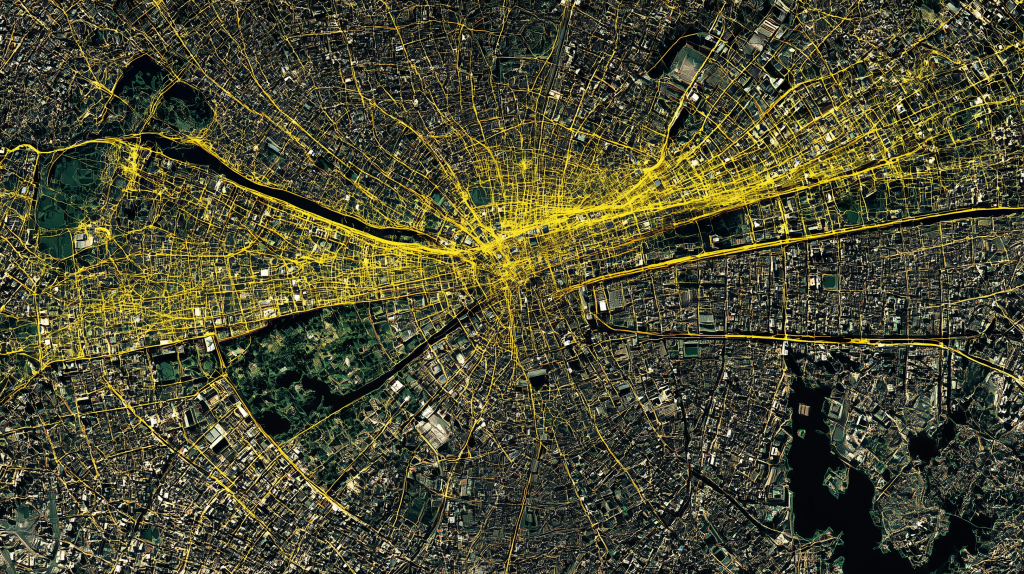
In 2010, a team of researchers led by Atsushi Tero at Hokkaido University in Japan published a study in Science that, on its surface, sounds absurd. They placed a slime mold (Physarum polycephalum, a brainless, single-celled organism) onto a wet surface shaped like the greater Tokyo metropolitan area. At 36 locations corresponding to cities and towns surrounding Tokyo, they placed small piles of oat flakes. They used light (which the organism avoids) to simulate geographical obstacles: mountains, lakes, bodies of water. Then they waited.
The slime mold did what slime molds do. It spread outward from the center, exploring its environment, extending thin tendrils in every direction. Over the course of about 26 hours, something remarkable happened. The organism pruned its initial sprawl into an efficient network of tubes connecting the food sources. When the researchers compared this network to the actual Tokyo rail system — a network that had been designed, revised, and optimized by human engineers over more than a century — the two were nearly identical. The slime mold had arrived at the same solution the engineers arrived at: how to move resources efficiently through a network of nodes, balancing throughput, redundancy, and cost.
It had no brain. No blueprint. No central planning. No understanding of what it was doing. It was a single organism, optimizing for food.
How does a brainless organism arrive at the same organizational solution as a century of human civil engineering? The standard answer is that both the organism and the engineers were subject to the same physical constraints. Networks that move resources through space face trade-offs between efficiency (short paths) and resilience (redundant paths), and physics limits the set of configurations that balance both well. Any system solving this problem, whether made of protoplasm or steel, will tend to converge on a similar structure.
That answer is correct. And it opens a question I believe is more consequential than it first appears: if physics dictates the shape of efficient networks regardless of what the network is made of, how many other organizational patterns are similarly dictated? If the same patterns keep appearing in biology, in technology, in cities, in economies, what does that convergence tell us about the nature of progress itself?
This essay argues that progress is not a random accumulation of inventions. It is a fractal process in which technology recreates biological organizational patterns at successively larger scales. This is not metaphor. It is structural convergence driven by physical law. The same organizational logic that built cells, built organisms, and built ecosystems is now building technological civilization. And we have evidence that this kind of transition has happened before, 2.4 billion years ago, with consequences that transformed the planet.
Part I: The Pattern
Convergence, Not Metaphor
The slime mold experiment is striking because it is visual and precise. You can lay the two networks side by side and see the resemblance. It is not a one-off. Independent convergences between biological and technological systems appear everywhere, once you start looking.
Take road networks and circulatory systems. Highways function as arteries, carrying large volumes at high speed. Local roads function as capillaries, branching into finer and finer divisions to reach individual destinations. Commuter traffic flows in and out of city centers in daily pulses that follow the same fluid dynamics equations governing blood flow through the heart. Nobody designed this analogy. Traffic engineers and evolutionary biology arrived at these structures independently, under the same physical constraints: how to move a substance (blood, cars) efficiently through a branching network that must reach every point in a volume.
The same convergence appears in communication systems. Packet-switched data networks route information through distributed nodes, dynamically adjusting paths based on congestion and availability. Biological nervous systems do the same thing: neural signals propagate through networks with variable routing, redundancy, and distributed processing. The internet was not designed to mimic the nervous system (its architecture emerged from Cold War military requirements for survivable communication), but it converged on the same topology because both systems solve the same underlying problem: reliable information transmission through a noisy, distributed medium.
Cities tell this story at the largest scale. Over decades and centuries, cities develop sewer systems (analogous to lymphatic drainage), electrical grids (analogous to metabolic energy distribution), water supply networks (analogous to circulatory nutrient delivery), and transportation systems (analogous to the circulatory system writ large). Nobody sat down and designed a city to look like an organism. These systems were added incrementally, by different people, in different centuries, in response to immediate practical needs. The result, viewed from above, is structurally convergent with a multicellular body plan.
Physical Constraint, Not Design
I want to be clear about what these convergences are and are not. They are not “biomimicry” in the design sense. Biomimicry is when an engineer studies a kingfisher’s beak and redesigns a bullet train nose. That is conscious imitation. The convergences I am describing are not imitations at all. They can and will emerge independently, without anyone noticing or intending the parallels.
When two entirely different substrates (biological tissue and human-engineered infrastructure) independently arrive at the same organizational solution, the solution is not a property of either substrate. It is a property of the constraints. The constraints are physical law: how energy, materials, and information can most efficiently move through spatially distributed networks under limits of cost, throughput, and redundancy.
The physicist Ilya Prigogine provided a theoretical framework for exactly this kind of convergence. Prigogine won the Nobel Prize in Chemistry in 1977 for showing that systems far from thermodynamic equilibrium spontaneously self-organize into what he called dissipative structures: ordered configurations that persist because they are effective at processing energy flows. A hurricane is a dissipative structure. A living cell is a dissipative structure. A city is a dissipative structure. All three are organized by the same thermodynamics. The fact that they converge on similar forms is not coincidence. It is constraint.
Part II: The Direction
Progress Is Irreversible
If the convergence between biology and technology were just a static resemblance, it would be a curiosity. Something to note and move on from. The reason it matters is that the convergence has a direction.
New technologies do not appear in isolation. They stack on existing ones, and each layer becomes infrastructure for the next. Fire enabled cooking, which enabled smaller jaws and larger brains. Metallurgy enabled machinery. Machinery enabled the industrial revolution. Electronics enabled computing. Computing enabled both the internet and AI. Each of these layers depends on the ones below it. You cannot have AI without computing, computing without electronics, electronics without metallurgy, metallurgy without fire. Remove any middle layer and everything above it collapses.
The economist and complexity theorist W. Brian Arthur argues in The Nature of Technology that technology is fundamentally combinatorial: new technologies are not invented from scratch but assembled from existing components, exactly like genetic recombination in biology. The space of possible technologies expands combinatorially with each new component added. Once a new technology exists, it becomes a building block for things that were previously impossible. The option space only grows. You can slow this process, but you cannot reverse it, because the dependencies only accumulate.
This is a structural observation about dependency, not a value judgment about improvement. Progress has a direction because the architecture of innovation is cumulative.
Magnetic, Not Inevitable
I want to be precise about what “direction” means here. I am not making a teleological claim. I am not arguing that the universe is progressing toward some predetermined goal, or that complexity is the “purpose” of evolution. Nothing in what follows requires purpose or intent.
The direction I am describing is better understood as a gradient. Picture a landscape of hills and valleys. A ball placed on a slope does not “want” to reach the valley. It rolls downhill because gravity acts on it. Place it on a different part of the slope and it may roll into a different valley. The destination is not predetermined, but the downward tendency is structural.
The equivalent of gravity, in this case, is thermodynamics. Complex systems that dissipate energy more efficiently tend to persist and proliferate. Not because the universe “prefers” complexity, but because efficient dissipation of energy gradients is what sustains far-from-equilibrium structures. Prigogine showed this mathematically. The astrophysicist Eric Chaisson quantified it. In his work on Cosmic Evolution, Chaisson developed a metric called Energy Rate Density: the amount of energy a system processes per unit mass per unit time, measured in erg/s/g.
Chaisson’s numbers are worth sitting with. A typical star processes about 2 erg/s/g. A planet, roughly 75. A plant, about 900. An animal body, around 20,000. The human brain processes approximately 150,000 erg/s/g. And human society as a whole, including its technological infrastructure, reaches roughly 500,000 erg/s/g.
The trend is not linear. It accelerates. Each level of organizational complexity processes energy at a rate orders of magnitude higher than the previous one. This is the measurable signature of the gradient I am describing: not progress toward a goal, but a thermodynamic tendency toward more efficient energy dissipation. Systems that find higher positions on this curve tend to persist. Systems that don’t tend to be replaced by systems that do.
Part III: The Fractal
The Same Logic at Every Scale
The convergences from Part I and the gradient from Part II combine into a specific structure. It repeats at every scale, and the repetition is what makes the argument.
At the molecular level: independent chemical units organized into collaborative systems with specialized internal structures (organelles) and communication channels (chemical signaling). The emergent result was the cell, a unit with properties (metabolism, reproduction) that no individual molecule possesses.
At the cellular level: independent cells organized into collaborative systems with specialized organs and communication networks (nervous systems, hormones). The emergent result was the multicellular organism, a unit with properties (coordinated behavior, consciousness) that no individual cell possesses.
At the organism level: independent organisms organized into collaborative systems with specialized roles (division of labor) and communication infrastructure (language, writing, roads). The emergent result was civilization, a unit with properties (cumulative knowledge, technological capability) that no individual organism possesses.
At the civilizational level: independent civilizations are organizing into collaborative systems with specialized global infrastructure and communication networks (the internet, AI, global supply chains). The emergent result is still forming.
At every level, the same logic: independent units → collaboration → specialization → communication → emergence → the whole becomes the new unit at the next scale. That repetition across scales is not metaphor. In mathematics, a structure that repeats its own pattern at every scale of magnification is called a fractal.
The Adjacent Possible
This fractal does not jump levels. It climbs them, one at a time.
The biologist Stuart Kauffman introduced the concept of the Adjacent Possible: the set of all things that are one step away from what currently exists. At any given moment, the next innovations are not random draws from all conceivable inventions. They are drawn from the set of possibilities that the current configuration makes available.
Once you have fire, cooking is the adjacent possible. Once you have smelted metal, the wheel is the adjacent possible. Once you have electricity, radio is the adjacent possible. Once you have computers, AI is the adjacent possible. Each door opens the next, and each opened door changes the shape of what is adjacent, expanding it in directions that were previously inaccessible.
This is why the fractal has a direction even though it has no destination. Each level’s existence is a precondition for the next. You cannot get to organisms without cells, or to civilization without organisms, or to AI without civilization. The staircase can only be climbed in order.
Part IV: The Precedent
The Great Oxidation Event
Everything I have described so far — the pattern, the direction, the fractal — could be dismissed as retrospective pattern-matching. The human brain is wired to see patterns, and seeing them does not make them real. The question is whether this particular pattern has independent evidence beyond the analogies themselves.
I believe it does, let’s look at the evidence starting 2.4 billion years ago:
The most successful organisms on early Earth were cyanobacteria. They had developed an extraordinarily effective metabolic innovation: oxygenic photosynthesis, the ability to use sunlight to split water molecules and release oxygen as a waste product. This was an enormously efficient energy strategy, and the cyanobacteria thrived.
But there was a problem. Oxygen was toxic to virtually every other form of life on the planet. The existing biosphere was anaerobic. Its organisms had evolved in an atmosphere with essentially no free oxygen (less than 0.001% of today’s levels). As cyanobacteria proliferated, their waste product accumulated. What followed was the first mass extinction event in Earth’s history: the Great Oxidation Event. Organisms that could not tolerate oxygen died in enormous numbers.
Life did not end. Some organisms evolved the ability to not just tolerate oxygen but to use it. Aerobic respiration, the metabolic pathway that burns glucose with oxygen, produces roughly 18 times more energy per glucose molecule than anaerobic fermentation (36 to 38 ATP molecules versus 2). The organisms that made this transition gained access to a vastly more powerful energy source. Over geological time, this energy advantage enabled the evolution of the eukaryotic cell, multicellular life, the Cambrian explosion of animal diversity, and eventually every complex organism on the planet. Including us.
The poison became the fuel. The crisis was the transition mechanism. The dominant life form’s waste product destabilized the existing equilibrium and created the conditions for something far more complex to emerge.
The Structural Parallel
Today, technological civilization has become so successful that its byproducts are breaking the dynamic equilibrium that sustained the biosphere for hundreds of millions of years. Plants, herbivores, carnivores, decomposers, scavengers: these ecological roles kept biological systems in dynamic balance through feedback loops of population and resources. Human technological success disrupted that balance. We are living through the sixth mass extinction. Species are disappearing at rates not seen since the end of the Cretaceous.
The parallel is systemic, not chemical. Different chemistry, same process. In both cases, a dominant form of organization succeeds to the point of destabilizing its own environment. The existing equilibrium breaks, and the disruption creates conditions that favor new forms of organization — forms that can operate under the new conditions more effectively than the old ones could.
After the Great Oxidation Event, the new conditions favored organisms that could process oxygen. Today, the new conditions (data saturation, global connectivity, ecological complexity beyond human cognitive capacity) favor systems that can process information, manage complexity, and operate at speeds biology cannot match. The structural pattern is: metabolic saturation → environmental crisis → phase transition → new level of organizational complexity.
This parallel does not guarantee a good outcome. Not every environmental crisis produces a clean transition. Many branches of the evolutionary tree end in extinction, not emergence. The Great Oxidation Event tells us what kind of event we are experiencing. It does not tell us how it ends. I will return to this.
Part V: The Merger
Endosymbiosis: When Life Swallowed Life
The Great Oxidation Event set the stage for one of the most consequential events in the history of life on Earth. Competition played its usual role in selecting which organisms survived the new oxygen-rich world. But the leap in complexity that followed — the one that ultimately produced every plant, animal, and fungus on the planet — happened through something else entirely: integration.
In 1967, a biologist named Lynn Sagan (later Lynn Margulis) published a paper in the Journal of Theoretical Biology titled “On the Origin of Mitosing Cells.” She proposed something the biological establishment found nearly heretical: that the eukaryotic cell (the cell type that makes up every plant, animal, and fungus on Earth) did not evolve through gradual mutation. It evolved through endosymbiosis. One single-celled organism engulfed another, and instead of digesting it, the two merged. The engulfed cell became the mitochondrion, the organelle that performs aerobic respiration, the “power plant” of the complex cell.
Margulis was ridiculed for years. Her paper was rejected by roughly fifteen journals before it found a home. The idea that the most important leap in cellular complexity happened through merger rather than competition contradicted the prevailing emphasis on competitive natural selection. Today, endosymbiosis is one of the most well-established facts in biology. Mitochondria retain their own DNA, replicate independently inside cells, and show clear evolutionary descent from ancient free-living bacteria. Margulis was right, and her central insight remains one of the most important in modern biology: the most consequential leaps in evolution did not happen through competition. They happened through integration. One organism absorbed another, and both became something neither could have been alone.
The Techno-Endosymbiosis
I believe Margulis’s framework applies directly to what is happening now.
When you sit behind the wheel of a car, you and the machine become linked as one organism. Your feet control its speed, your hands its direction. You grow additional eyes (side mirrors, rearview) so you can see in more directions. You move at speeds your body was never designed for, through networks that behave like circulatory systems, flowing in and out of city centers each day. For the duration of the drive, you are not a human using a machine. You are a human-machine symbiont.
A smartphone takes this further, from the physical into the cognitive. It is not a tool in the way a hammer is a tool. A hammer extends your physical capability and then you put it down. A smartphone has become an extension of your cognitive and social metabolism. You navigate with it, remember with it, communicate through it, think with it. Research consistently shows that people separated from their smartphones perform measurably worse on cognitive tasks, including memory and spatial reasoning. The device is not something you use. It is something you are, in part, made of. Remove it, and your capabilities diminish in measurable ways.
An AI assistant takes this even further still. When you write with an AI, the boundary between your thinking and the machine’s processing is not clean. Ideas flow in both directions. The output is neither fully yours nor fully the machine’s. It is the product of a cognitive symbiosis.
From Margulis’s perspective, this has a name. It is endosymbiosis at a new scale. Two billion years ago, a cell and a bacterium merged to form something more complex than either. Today, a human and a computational system are merging to form something more capable than either. The fractal repeats: integration at the cellular level, recapitulated at the organism-technology level. Margulis documented the precedent. We are living the recurrence.
Part VI: The Objection
Gould’s Challenge
The strongest objection to everything I have argued comes from one of the most brilliant evolutionary biologists of the twentieth century: Stephen Jay Gould.
In Full House (1996) and Wonderful Life (1989), Gould argued that the appearance of directionality in evolution is an illusion. His analogy is vivid: imagine a drunk person walking along a sidewalk with a wall on one side and a gutter on the other. The drunk lurches randomly. Eventually, they fall into the gutter. Not because they intended to, not because the gutter attracted them, but because the wall on one side prevents leftward movement. The “complexity” of life appears to increase over time for the same reason: there is a “left wall” of minimal complexity (you cannot get simpler than a single self-replicating molecule), and random variation will occasionally produce organisms that happen to be more complex. Over billions of years, the rightward tail of the distribution extends. It looks like progress. Gould argued it is a random walk with a boundary.
His most famous thought experiment puts it starkly. “Replay the tape of life.” Rewind Earth to the Precambrian and press play again. You would not get humans, or mammals, or vertebrates, or possibly even multicellular life. You would get something unrecognizably different, because evolution depends on specific accidents (the particular asteroid that killed the dinosaurs, the particular mutations that arose at particular moments), and those accidents would not repeat.
This is a serious objection. It strikes at the heart of my argument: that the fractal I have described is a real structure, not a story imposed on complex data after the fact. So let’s engage with it directly.
The Convergence Counter
The paleontologist Simon Conway Morris, in his 2003 book Life’s Solution: Inevitable Humans in a Lonely Universe, offers the most direct response to Gould.
If evolution were truly random — if the tape of life could produce anything at all when replayed — you would not expect the same solutions to evolve independently in unrelated lineages. And yet they do. Repeatedly.
Eyes have evolved independently at least 40 times across the animal kingdom (per the classic estimate by Salvini-Plawen and Mayr, 1977). Flight evolved independently in insects, pterosaurs, birds, and bats. Echolocation evolved independently in bats and dolphins. Warm-bloodedness evolved independently in mammals and birds. Intelligence and tool use evolved independently in primates, corvids, and cephalopods. These are not minor similarities. They are major functional innovations appearing independently in organisms separated by hundreds of millions of years of evolution.
Conway Morris’s argument is that convergent evolution reveals attractors in the fitness landscape. Certain solutions are so efficient, so well-suited to the physical constraints of life on a planet like Earth, that evolution finds them repeatedly. They are not inevitable in any single lineage. Any particular species might never evolve eyes. Given enough lineages and enough time, eyes will almost certainly appear somewhere, because the physics of electromagnetic radiation and the biochemistry of photoreception make eyes an extraordinarily effective solution to the problem of navigating a light-filled environment.
This applies directly to the technology-biology convergences from Part I. The slime mold and the Tokyo rail system converge because efficient network topology is an attractor. Neural signaling and internet architecture converge because distributed redundant communication is an attractor. Endosymbiosis recurs (both in Margulis’s biology and in the human-technology merger) because integration is more energy-efficient than competition at certain scales.
The fractal is not a script. Nothing guarantees that any specific branch will produce a specific outcome. The fractal is a set of thermodynamic attractors that different substrates tend to find, because the constraints are physical and the physics does not change.
Part VII: What the Pattern Does Not Tell Us
Honest Limits
The pattern tells us what kind of event we are in. It does not tell us the outcome.
The Great Oxidation Event produced multicellular life. It also killed most of the organisms alive at the time. No cyanobacterium could have predicted rainforests, octopuses, or Mozart. Evolution is a branching tree, and the tree itself is a fractal: it repeats its own branching structure at every scale. Not every branch bears fruit. More species have gone extinct in Earth’s history than have evolved into something new. The fact that a transition of this kind has occurred before does not guarantee that this one ends well for any particular species, including ours.
We are still in the early, chaotic phase of this disruption. Many paths remain open. Predicting the specific outcome from here would be like turning soil, watching the first weeds appear, and claiming to know whether this patch becomes a prairie, a forest, or a parking lot. For what it is worth, I am a long-term optimist about where this trajectory leads, and a short-term pessimist about how gracefully we navigate it.
A Measurable Indicator
Chaisson’s Energy Rate Density provides one way to track this. If the emergent technological-biological system continues along the trajectory that every previous level of the fractal has followed, it should exhibit a measurable increase in energy processing efficiency over time. And if complexity continues to increase even as raw energy consumption stabilizes or declines, that would be its own kind of evidence: a signal that the organizing force of progress can defy the entropic patterns that held before it.
Part VIII: The View from Outside
From inside, transitions look like collapse: species disappearing, equilibria breaking, the familiar dissolving, the ground shifting under your feet. From outside — from the distance of 2.4 billion years — transitions look like emergence.
Every previous level of the fractal was invisible to the organisms living through it. Molecules did not know they were becoming cells. Cells did not know they were becoming organisms. We are at the unique transition level of the fractal, reflecting upon and observing the pattern while it is still unfolding.
Sebastian Chedal writes about the intersection of mathematics, information theory, AI, and the philosophy of technology.
Sources for Further Reading and Research
Big History and Long-Run Progress
- David Christian, Maps of Time: An Introduction to Big History – University of California Press.
ucpress.edu - David Christian et al., Big History: Between Nothing and Everything – McGraw-Hill.
boffosocko.com
Fractals, Systems, and “Fractal Change”
- Pravir Malik, Connecting Inner Power with Global Change: The Fractal Ladder – SAGE.
sk.sagepub.com - Pravir Malik, Connecting Inner Power with Global Change – executive summary and review.
councils.forbes.com - Human Systems Dynamics Institute – “Fractals: A Lever to Change the World.”
hsdglobalservices.org - Emma Proud – “The power of fractals: patterns to create change.”
emmaproud.substack.com
Geometry, Conceptual Spaces, and Thought
- Peter Gärdenfors, Conceptual Spaces: The Geometry of Thought – MIT Press.
portal.research.lu.se - “The Geometry of Thought” – academic article on geometry of conceptual and semantic spaces.
academia.edu
Complexity, Scaling, and Progress
- Geoffrey West, Scale: The Universal Laws of Life, Growth, and Death in Organisms, Cities, and Companies.
goodreads.com - Per Bak, How Nature Works: The Science of Self-Organized Criticality.
goodreads.com - John H. Holland, Hidden Order: How Adaptation Builds Complexity.
goodreads.com
Progress, Development, and Optimism
- Steven Pinker, Enlightenment Now: The Case for Reason, Science, Humanism, and Progress.
goodreads.com - Hans Rosling, Factfulness: Ten Reasons We’re Wrong About the World — and Why Things Are Better Than You Think.
goodreads.com
Memes and Cultural Evolution
- Richard Dawkins, The Selfish Gene.
goodreads.com - Susan Blackmore, The Meme Machine.
goodreads.com
Organizational Learning and Systems Change
- Peter M. Senge, The Fifth Discipline: The Art & Practice of the Learning Organization.
goodreads.com - Chris Argyris & Donald Schön, Organizational Learning II: Theory, Method, and Practice.
goodreads.com