The Geometry of Thought: Why the Universe Doesn’t Stop at Three Dimensions
The Photo That Shouldn’t Exist
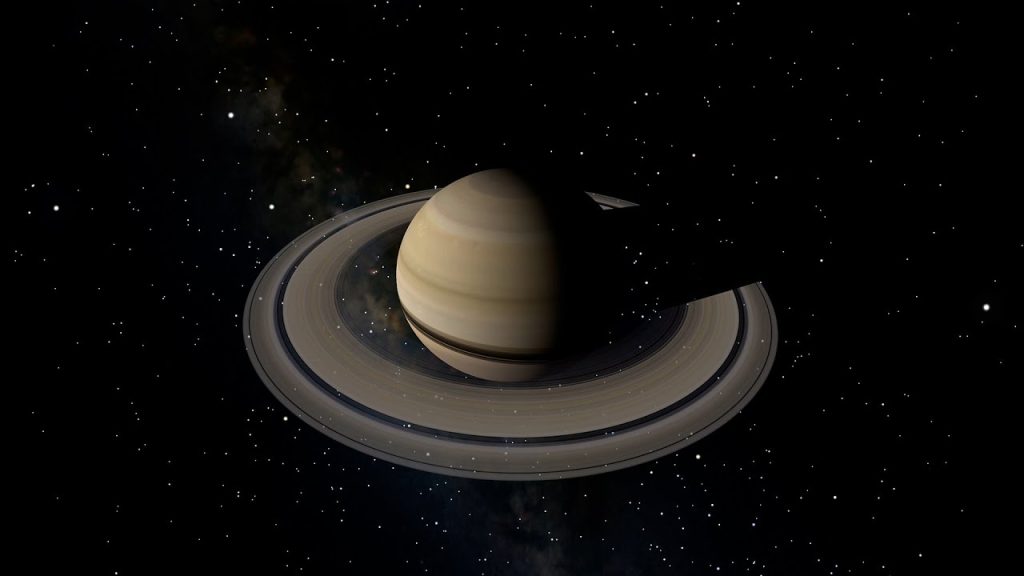
In 1981, the Voyager 2 spacecraft was hurtling past Saturn at roughly 35,000 miles per hour, nearly a billion miles from Earth. Its radio transmitter was about as powerful as a refrigerator light bulb — roughly 23 watts. The signal it sent back to NASA’s Deep Space Network was, by the time it arrived, trillions of times weaker than the background noise of the universe itself.
And yet, the photos arrived crystal clear. Crisp, detailed images of Saturn’s rings, its moons, its atmosphere. Images that changed our understanding of the solar system and that still take your breath away four decades later.
How? How do you pull a clean photograph out of a whisper buried in static, sent from nearly a billion miles away?
The answer is not brute force. NASA didn’t just crank up the volume. The answer is geometry. Not the geometry you typically learn in school. Voyager’s communication system relied on a mathematical structure that lives in twenty-three dimensions. Not three. Not four. Twenty-three.
That structure is called the Golay Code, and its existence raises a question that I believe most people — even most scientists — have not fully reckoned with: If we routinely solve physical problems by reaching into mathematical spaces of 23 or more dimensions, and those solutions produce real, measurable, physical results, then in what sense are those dimensions not real?
This essay is an attempt to follow that question wherever it leads. The path will take us through Pascal’s Triangle, information theory, the largest symmetry object in mathematics, thermodynamics, evolutionary biology, and the philosophy of consciousness. These are subjects that don’t usually appear in the same room together. But I believe they are all facets of a single, deeper truth: that we do not live in a 3+1 dimensional universe. We live in something far larger, and the “extra” dimensions — the informational, mathematical, and conceptual structures we interact with every day — are not convenient fictions. They are as real as the ground beneath your feet.
Part I: The Seed
Pascal’s Triangle as a Map of Choice
Everything in this argument begins with one of the simplest objects in mathematics: Pascal’s Triangle.
You may remember it from school. It is a triangle of numbers where each entry is the sum of the two entries directly above it. The top is 1. The next row is 1, 1. Then 1, 2, 1. Then 1, 3, 3, 1. And so on, cascading downward forever.
         1
        1 1
       1 2 1
      1 3 3 1
     1 4 6 4 1
    1 5 10 10 5 1
Most people see this as a curiosity, a pattern you build for fun. To a mathematician, Pascal’s Triangle is something much deeper. It is a map of every possible way to make a sequence of binary choices.
Suppose you flip a coin once. There are two outcomes: Heads or Tails. That is Row 1 of Pascal’s Triangle (1, 1). Now flip it twice. There are four possible sequences: HH, HT, TH, TT. But how many of those sequences contain exactly one Head? Two of them (HT and TH). That is Row 2: 1, 2, 1. One way to get zero heads, two ways to get one head, one way to get two heads.
Each row of the triangle corresponds to adding one more independent binary choice — one more coin flip. And in mathematics, every independent binary choice is equivalent to adding a new dimension.
This is the conceptual foundation for everything that follows.
Think about what a “dimension” actually means. In everyday life, we use the word to describe spatial directions: up/down, left/right, forward/backward. That is just one application of a more general idea. A dimension, in its purest mathematical sense, is an independent degree of freedom. It is a direction in which you can move or vary something without affecting any other direction.
When you flip a coin, the result (Heads or Tails) is a single degree of freedom — a single dimension. When you flip two coins, you have two independent degrees of freedom, two dimensions. The set of all possible outcomes can be represented as the corners of a square. Three coins? Three dimensions. The outcomes are the corners of a cube. Four coins? A hypercube, a four-dimensional object that we cannot visualize but can describe and work with mathematically with perfect precision.
Row 1 of Pascal’s Triangle maps the outcomes of a 1-dimensional space (a line segment). Row 2 maps a 2-dimensional space (a square). Row 3 maps a 3-dimensional space (a cube). Row 10 maps a 10-dimensional hypercube. Row 23 maps a 23-dimensional hypercube.
As the triangle grows, the dimensionality climbs without limit. Pascal’s Triangle is not just a number pattern. It is a staircase into higher-dimensional space.
Beyond Three Dimensions
At this point, a reasonable person might ask: “So what? I can define a 23-dimensional mathematical space. I can also define a unicorn. That doesn’t make either of them real.”
Fair enough. And I will argue later in this essay that the premise of this objection — that an idea must have physical consequences to count as “real” — is itself the wrong standard. But for now, let us meet the skeptic on their own terms. Because the higher rows of Pascal’s Triangle are not inert abstractions. They turn out to be essential tools for solving one of the most fundamental problems in physics: the problem of noise.
Part II: The Problem of Noise
Information Degrades
Every time information travels from one place to another, something goes wrong. It doesn’t matter if it’s a radio signal crossing the solar system, a text message crossing a cell tower, or a strand of DNA being copied inside a dividing cell. Bits flip. Letters change. Signals degrade. Noise is not an occasional nuisance; it is a fundamental feature of the physical universe. The second law of thermodynamics guarantees it: entropy increases, and entropy corrupts information.
In 1948, Claude Shannon, working at Bell Labs, published a paper called “A Mathematical Theory of Communication” that essentially founded the field of information theory. Shannon proved something remarkable: for any noisy channel, there exists a theoretical limit — now called the Shannon limit — to how much information you can reliably transmit. Below that limit, it is mathematically possible to communicate with zero errors, even through noise. Above it, errors become inevitable.
But Shannon’s proof was an existence proof. He showed that perfect error correction was possible in theory. He did not show how to build it. That was the challenge that consumed mathematicians and engineers for the next several decades: find practical codes that approached Shannon’s theoretical limit. Find ways to pack information so efficiently that errors could be detected and corrected without wasting transmission capacity.
The search for these codes is what led mathematicians into higher-dimensional geometry, and ultimately to Row 23 of Pascal’s Triangle.
Sphere-Packing: The Geometry of Efficiency
To understand why error correction is a geometric problem, consider a simple analogy.
Imagine you are packing oranges into a crate. You want to fit as many oranges as possible into the available space, with no gaps. In two dimensions, this is the problem of packing circles on a flat surface, a problem solved centuries ago (hexagonal packing, like a honeycomb, is optimal). In three dimensions, it is the problem of stacking spheres, conjectured by Kepler in 1611 and not formally proved until 1998.
Now imagine the same problem, but in 23 dimensions. Instead of spheres, you are packing 23-dimensional “hyperspheres” into a 23-dimensional space. Each hypersphere represents a “neighborhood” around a valid codeword: the set of all messages that are close enough to the original that they can be correctly decoded even if some bits get flipped during transmission.
A “perfect code” is one where the hyperspheres pack together with zero wasted space: every possible received message falls inside exactly one neighborhood, and every neighborhood corresponds to exactly one valid codeword. No ambiguity. No gaps. Maximum efficiency.
In practice, the data being sent is always at the center of one of these spheres. If noise shifts the received signal away from the center, the system moves the data point “back” to the nearest center. The tolerance of the system is measured by the size of the spheres you can pack with no leftover space in a single transmission packet.
Perfect codes like this are extraordinarily rare. In fact, proving that one exists in a given dimensionality is a major mathematical event. And one of the most elegant perfect codes ever discovered was found hiding in Row 23 of Pascal’s Triangle.
Part III: The Miracle of Row 23
The Golay Code
In 1949, a Swiss mathematician named Marcel Golay noticed something remarkable about the 23rd row of Pascal’s Triangle. The numbers in that row begin:
1, 23, 253, 1771, 8855, …
If you sum the first four of these numbers — the number of ways to choose 0, 1, 2, or 3 items from a set of 23 — you get:
1 + 23 + 253 + 1771 = 2,048 = 2¹¹
This is, on its face, a numerical coincidence. In the world of binary coding, it is seismic.
A binary code of length 23 has 2²³ possible codewords (roughly 8.4 million). If you want to be able to correct up to 3 errors in any received word, each valid codeword needs a “neighborhood” containing every word within a distance of 3 bit-flips. The size of that neighborhood is exactly the sum we just computed: 2,048 = 2¹¹.
This means that if you choose 2²³ ÷ 2¹¹ = 2¹² = 4,096 valid codewords, their neighborhoods will tile the entire 23-dimensional space perfectly. No overlaps. No gaps. Every possible received message can be decoded to exactly one valid codeword, correcting up to 3 errors automatically.
This is the binary Golay code: a perfect 3-error-correcting code in 23 dimensions. It is one of only a handful of perfect codes known to exist, and its perfection depends entirely on that numerical coincidence in Pascal’s Triangle — the fact that a particular sum of binomial coefficients happens to be an exact power of 2.
To be clear about what “miracle” means here: there is nothing mystical about it. It is a provable mathematical fact. But perfect codes are so rare, and the conditions for their existence so stringent, that the Golay code’s existence feels less like a construction and more like a discovery — as if the code were already there, embedded in the structure of combinatorics, waiting to be found.
Voyager’s 23-Dimensional Navigator
When NASA’s Jet Propulsion Laboratory needed to design the communication system for the Voyager missions in the 1970s, they chose a variant of the Golay code as the backbone of their error-correction scheme. The reasons were simple: it was astonishingly efficient, it could correct multiple simultaneous bit-flips, and it could be decoded quickly enough for real-time use.
Every photograph Voyager sent back from Jupiter, Saturn, Uranus, and Neptune was encoded using this 23-dimensional geometry. When cosmic radiation flipped bits during the signal’s billion-mile, speed-of-light journey back to Earth, the Golay code’s perfect sphere-packing meant that the corrupted signal could be mapped back to the correct original. Not approximately. Exactly.
NASA engineers were not just doing arithmetic. They were navigating a 23-dimensional landscape to recover information that existed physically as radio waves traveling through 3-dimensional space. The higher-dimensional structure was not a metaphor. It was the mechanism.
Part IV: Soaking In It
Error Correction Is the Infrastructure of Modern Life
Today, you cannot participate in modern civilization without continuously relying on mathematical structures that exist in high-dimensional spaces.
Telecommunications. Every 5G signal your phone receives is encoded using Low-Density Parity-Check (LDPC) codes and polar codes. These are mathematical structures that operate in spaces of hundreds or thousands of dimensions. When you stream video, make a phone call, or send a text, your data is being encoded, transmitted through noise, and decoded using geometric relationships in spaces far beyond anything you can visualize. The clarity of your call depends on the perfection of those geometries.
Data Storage. Every hard drive, SSD, and cloud server uses Reed-Solomon codes or turbo codes to protect your data against physical degradation: magnetic fields weakening, electrons tunneling, bits decaying. Your files persist not because the physical medium is perfect, but because the mathematical structures that guard them are robust in dimensions you will never see.
QR Codes. The black-and-white squares on restaurant menus and boarding passes are Reed-Solomon encoded. You can scratch, smudge, or partially obscure a QR code, and your phone will still read it — because the code exists in a mathematical space where the damaged version is still “close enough” to the original to be uniquely decoded.
Artificial Intelligence. When a large language model processes your question or a neural network recognizes a face, it is operating in a space of millions or billions of dimensions — one for each parameter in the model. “Training” the model means finding a point in that high-dimensional space where the model’s outputs match reality. Inference means navigating that space in real time. AI is, at its core, high-dimensional geometry made practical.
Biology. And perhaps most remarkably, nature has been operating in high-dimensional spaces long before we had a name for them. Your brain contains roughly 86 billion neurons, each capable of independent activity, each a separate degree of freedom in mathematical terms. The state of your brain at any given moment is a point in a space of billions of dimensions. When you recognize a face, recall a memory, or weigh a difficult decision, your neural activity traces a trajectory through this vast space, navigating along low-dimensional structures — manifolds, attractors, saddle points — that neuroscientists are only now beginning to map. The higher geometry of thought is not a metaphor. It is a literal description of what your brain is doing when you think.
The point is this: high-dimensional mathematical structures are not curiosities confined to a mathematician’s chalkboard. They are the active, working infrastructure of communication, computation, biology, and intelligence. We use them every second of every day. The question is whether that use tells us something about the nature of reality.
Part V: The Doorway to the Monster
From Codes to Symmetry
The Golay code’s story does not end with Voyager. In fact, its most profound implications have nothing to do with engineering at all.
Mathematicians discovered that the Golay code possesses an extraordinarily rich set of symmetries: transformations that rearrange the code’s structure without destroying it. If you think of the Golay code as a crystal in 23-dimensional space, its symmetries are the ways you can rotate, reflect, and permute that crystal so that it maps perfectly back onto itself.
The group of all such symmetries is called the Mathieu group M₂₃, and it is one of the most remarkable objects in mathematics. It belongs to a family called the “sporadic” finite simple groups — objects that do not fit into any of the well-known infinite families of symmetry groups but instead exist as one-off, irreducible structures. They are, in a sense, the “atoms” of symmetry: every finite symmetry, no matter how complex, can be decomposed into these simple building blocks, just as every molecule can be decomposed into atoms.
There are exactly 26 sporadic groups. The effort to find and classify all of them ranks among the most ambitious intellectual projects in human history. The Classification of Finite Simple Groups — sometimes called the Enormous Theorem — was a collective endeavor spanning roughly fifty years and involving over a hundred mathematicians across dozens of countries. The proof, spread across hundreds of journal articles, totals an estimated 10,000 to 15,000 pages. The final gap was not closed until 2004, when Michael Aschbacher and Stephen Smith completed the classification of quasithin groups, meaning the full map of symmetry’s fundamental building blocks was finished only in our lifetime. Think of it as the mathematical analog of the Human Genome Project: a comprehensive atlas, not of biological life, but of the elemental symmetries from which all finite structure is composed.
The Mathieu groups, derived from the symmetries of the Golay code, are among the smallest of these 26 sporadic groups. At the other end of the spectrum, at the very summit of the hierarchy, sits an object called the Monster Group.
The Monster
The Monster Group is the largest of the sporadic groups, and its scale defies casual comprehension. It contains approximately 8 × 10⁵³ elements — a number comparable to the estimated number of atoms in the Sun. The smallest space in which you can faithfully represent the Monster as a set of symmetry operations has 196,883 dimensions.
This is not a number chosen for dramatic effect. It is a theorem. The Monster Group, an irreducible building block of the universe’s symmetry structure, requires a space of nearly 200,000 dimensions to express itself.
The Monster’s significance extends beyond its scale. In 1979, the mathematician John McKay noticed that 196,884 — one more than the Monster’s critical dimension — appeared as the first non-trivial coefficient in a function called the j-invariant, which belongs to an entirely different branch of mathematics (the theory of modular forms, connected to number theory and the geometry of the complex plane). This was not supposed to happen. These two areas of mathematics had no known connection.
The ensuing investigation, whimsically dubbed “Monstrous Moonshine,” was eventually proved by Richard Borcherds in 1992, earning him the Fields Medal, the highest honor in mathematics. It revealed deep connections between the Monster Group, modular forms, and — perhaps most suggestively — the mathematics of string theory and conformal field theory in physics.
The Monster Group is vast, and it appears to be connected to the deep structure of physical reality itself. It lives in a space of 196,883 dimensions.
Part VI: The Map and the Territory
Confronting the Obvious Objection
At this point, I imagine a certain kind of reader — a careful, rigorous thinker — is formulating an objection that goes something like this:
“Fine, the Golay code lives in 23 dimensions and the Monster lives in 196,883. But these are mathematical abstractions: marks on a chalkboard, patterns in a computer’s memory. They are maps, not territory. Using a 23-dimensional map to navigate a 3-dimensional radio signal does not mean that 23-dimensional space ‘exists’ any more than a map of Middle-earth means that Mordor exists.”
This is a serious objection, and it has a name in philosophy: the distinction between the map and the territory, borrowed from Alfred Korzybski and memorably illustrated by Magritte’s painting of a pipe with the caption “Ceci n’est pas une pipe” (“This is not a pipe”). The painting of a pipe is a representation. You cannot stuff it with tobacco. Similarly, the argument goes, a mathematical model of 23-dimensional space is a representation. You cannot walk around in it.
I want to engage with this objection directly, because I believe it ultimately fails. It rests on an unstated assumption about what “real” means, and that assumption, once examined, opens a far more interesting question than the one it was trying to close.
The Light Test
Consider light. A photon has no mass. It has no physical substance in the way that a rock or a table does. You cannot hold it, weigh it, or put it in a box (well, not easily). For centuries, natural philosophers debated whether light was “real” or merely an effect: a disturbance, a quality of the medium, an illusion.
We now know that light is unambiguously real. It carries energy. It exerts pressure. It bends the trajectories of physical objects. It is a fundamental constituent of the universe, despite having zero mass. The fact that it doesn’t behave like a billiard ball does not make it less real; it means our definition of “real” was too narrow.
I believe the same logic applies to informational and mathematical structures. The 23-dimensional Golay code has no mass. You cannot hold it. But it has location (it exists in every transmitter and receiver that implements it), it requires energy (to compute, to store, to transmit), and it produces physical consequences (clear photographs from Saturn, functioning 5G networks, preserved genomes). If we accept that light is real despite having no mass, on what grounds do we insist that a mathematical structure with energy, location, and causal power is not?
Part VII: Three Pillars
The Case for Informational Realism
Let me build the affirmative case on three pillars, each drawn from a different discipline, each independently strong, and together, I believe, decisive.
Pillar 1: Information Is Physical (Landauer’s Principle)
In 1961, the physicist Rolf Landauer, working at IBM, proved a remarkable theorem: the act of erasing one bit of information in any physical system necessarily dissipates a minimum amount of energy as heat. This minimum is kT·ln(2), where k is Boltzmann’s constant and T is the temperature. At room temperature, this works out to roughly 2.87 × 10⁻²¹ joules.
The number is small. The implications are enormous. Landauer’s Principle means that information is not separate from physics. It is bound to the laws of thermodynamics. You cannot create, destroy, or transform information without a corresponding physical event. Information is not a description written on top of reality; it is woven into reality’s fabric at the most fundamental level.
The physicist John Archibald Wheeler, one of the towering figures of 20th-century physics and the man who coined the terms “black hole” and “wormhole,” took this idea to its logical conclusion with his famous dictum: “It from bit.” Wheeler argued that every physical quantity, every particle, every field, derives its existence from information. The universe, at bottom, is not made of matter. It is made of answers to yes/no questions. It is made of bits.
If Wheeler is right — and the trajectory of modern physics, from quantum information theory to the holographic principle, increasingly suggests he is — then the distinction between “physical dimensions” and “informational dimensions” is not a distinction between real and unreal. It is a distinction between two manifestations of the same underlying substance.
Pillar 2: Emergence Is Real, Not Illusory (Against Greedy Reductionism)
The second objection to informational realism is what I call the “substrate” argument. It goes like this: “The 23-dimensional Golay code only exists because physical electrons are moving through physical silicon, or physical neurons are firing in a physical brain. The code is substrate-dependent. It cannot exist on its own. Therefore, only the physical substrate is real; the code is just a pattern in the substrate.”
This argument has a name: the philosopher Daniel Dennett called it Greedy Reductionism. It is the error of insisting that only the lowest level of description is real, and that all higher levels are “merely” emergent and therefore illusory.
But consider where greedy reductionism leads. A human being is “just” a collection of cells. A cell is “just” a collection of molecules. A molecule is “just” a collection of atoms. An atom is “just” a collection of quarks and electrons. A quark is “just” an excitation of a quantum field.
If only the lowest level is real, then you are not real. Your thoughts are not real. Biology is not real. Chemistry is not real. Only quantum fields are real, and everything else is an illusion.
No serious scientist or philosopher accepts this conclusion. Instead, we recognize that reality is organized into a hierarchy of emergent levels, each of which is genuinely real and each of which has its own laws, properties, and causal powers that cannot be reduced to the level below. Biology is real even though it depends on chemistry. Psychology is real even though it depends on neuroscience. And information is real even though it depends on physical substrates — just as you are real even though you depend on carbon, oxygen, and water.
The Golay code depends on silicon or neurons to instantiate it, just as you depend on cells to instantiate you. That dependence does not make either of you less real. It makes you part of a hierarchy.
Pillar 3: Top-Down Causation (Ideas Move Atoms)
The third objection is about causality: “Physical dimensions enforce reality. If you step off a cliff, gravity pulls you down regardless of what you believe. But mathematical dimensions are passive — they cannot reach out and physically move anything. Therefore, they are not real in the same way.”
This objection feels intuitive, but it is empirically false. Ideas cause physical events all the time. In complex systems theory, this is called top-down causation, and it is one of the most well-documented features of hierarchically organized systems.
Consider: the abstract, non-physical concept of a “law” physically puts a human body behind steel bars. The abstract, non-physical concept of a “stock price” causes physical factories to open or close, physical goods to be manufactured or destroyed. The abstract, non-physical concept of the “Golay Code” physically caused human beings to mine silicon from the earth, refine it into wafers, etch circuits onto those wafers, and launch a spacecraft carrying those circuits into the outer solar system.
The 23-dimensional geometry of the Golay code reached down the causal hierarchy and rearranged the physical atoms of our world. It caused mountains to be excavated, metals to be smelted, rockets to be built. If that is not causal power, the phrase has no meaning.
Yes, the causal chain is indirect. The code operates through engineers, through designs, through manufacturing processes. Causality in the physical world is always indirect at some level. Gravity does not “reach out and push.” It curves spacetime, and objects follow geodesics in that curved space. The indirectness of informational causation does not make it less real; it makes it hierarchical, which is exactly what we observe in every other domain of reality.
Part VIII: The Interface
Donald Hoffman and the Case Against Naive Realism
If we accept that information is physical, that emergence is real, and that ideas have causal power, a deeper question presents itself: What if our 3+1 dimensional experience of the world is not fundamental reality at all, but rather a simplified interface — an evolutionary shortcut that helps us survive but hides the true structure of the universe?
This is the argument advanced by the cognitive scientist Donald Hoffman in his Interface Theory of Perception. Hoffman’s core insight is drawn from evolutionary biology: natural selection does not optimize organisms for perceiving truth. It optimizes them for fitness — for survival and reproduction. And there is no guarantee that truth and fitness are the same thing.
Hoffman uses a computer desktop analogy. When you see a blue rectangular icon on your screen, you do not believe that the file it represents is literally blue, literally rectangular, or literally located in the upper-left corner of your computer. The icon is a useful fiction — an interface element that lets you interact with the underlying computational reality without needing to understand voltages, transistor states, and magnetic orientations on a disk platter.
Hoffman argues that our entire perceptual experience of space, time, and physical objects plays the same role. The three spatial dimensions and one time dimension we perceive are not the fundamental structure of reality. They are the icons on our evolutionary desktop, a user interface that was selected not because it is true, but because it is useful for a medium-sized primate trying to find food and avoid predators on the African savanna.
If Hoffman is correct, then the high-dimensional mathematical structures we have been discussing — the 23-dimensional Golay code, the 196,883-dimensional Monster, the billion-dimensional parameter spaces of neural networks — are not exotic departures from “normal” reality. They may be closer to the actual structure of reality than the 3D world we experience. Our senses are the bottleneck, not the universe.
This is a strong claim, and it is important to note that Hoffman’s theory is still debated in philosophy of mind and cognitive science. But its core premise — that perception is an interface, not a window — is increasingly supported by work in evolutionary game theory, neuroscience, and the physics of quantum information. At minimum, it deserves serious consideration.
Part IX: The Living Dimension
Memetics and the Causal Life of Ideas
There is one more thread to weave in: the idea that mathematical and informational structures are not just real, but alive — or at least that they exhibit the core properties we associate with living things.
In 1976, the evolutionary biologist Richard Dawkins coined the term meme (from the Greek mimeme, meaning “that which is imitated”) to describe a unit of cultural information that replicates, varies, and undergoes selection in a manner analogous to biological genes. Dawkins’ insight was that the logic of evolution — replication, variation, selection — is not limited to DNA. It applies to any information that can copy itself with variation in a competitive environment.
Consider the trajectory of the Golay code through this lens. In 1949, the code was “born,” instantiated for the first time in Marcel Golay’s mind and in his published paper. It then replicated: other mathematicians read the paper, understood the code, and instantiated it in their own minds. It evolved: engineers adapted it, optimized it for specific hardware, combined it with other codes. It competed: against alternative error-correction schemes, surviving because of its superior fitness (its perfect efficiency). It colonized new substrates: from paper to vacuum tubes to silicon chips to spacecraft. It caused its hosts to act: engineers, driven by the code’s utility, built physical infrastructure to support its propagation.
From the perspective of the Golay code itself — if we permit ourselves that thought experiment — it is an entity that has used human minds, hands, and industrial capacity as a reproductive mechanism. It has persisted for over 75 years, spread across the planet, launched itself into the outer solar system, and shows no signs of dying. It has rearranged more physical matter than most biological organisms ever will.
Is the Golay code “alive”? Not in the biological sense. It does not metabolize, it does not have cell walls, it does not satisfy every criterion on every checklist. But it replicates, it evolves, it competes, it persists, and it causes physical change in the world. If we define life by its functional properties rather than by its specific chemistry, the boundary between biological organisms and informational entities begins to dissolve.
And this dissolution is precisely the point. The traditional hierarchy holds that physics is real, biology is real, but ideas are “just” ideas. It fails to account for the fact that ideas exhibit the same functional behaviors as the entities we already accept as real. They are born, they replicate, they compete, they die, and along the way, they rearrange the atoms of the physical world to serve their propagation.
If an informational structure can do all of that, the burden of proof shifts. Denying that information is real requires explaining how something unreal manages to replicate, compete, persist, and rearrange the atoms of the physical world.
Part X: The Hierarchy of Dimensions
Putting It All Together
Let me now state the argument in its complete form.
We are taught that we live in a universe of 3+1 dimensions: three spatial, one temporal. This is the “territory,” the stage on which physics plays out.
The evidence suggests this picture is radically incomplete. Above the physical dimensions sits an informational layer of reality that is:
- Physical, in the sense that it is bound to the laws of thermodynamics (Landauer’s Principle) and requires energy to create, maintain, and destroy.
- Genuinely emergent, in the same sense that biology is genuinely emergent from chemistry — not “merely” a pattern in a substrate but a level of reality with its own laws and properties (against greedy reductionism).
- Causally powerful, capable of reaching down the hierarchy to rearrange physical matter through top-down causation. Just as a law can imprison a body, a mathematical code can launch a spacecraft.
- Potentially more fundamental than the 3+1 dimensional experience we perceive, if our perceptual system is an evolutionary interface rather than a transparent window onto reality (Hoffman’s Interface Theory).
- Alive in the functional sense, exhibiting replication, variation, selection, and competitive persistence across substrates (memetics).
The dimensions of this informational layer are not bounded by three, or four, or any finite number. They extend to 23 (the Golay code), to 196,883 (the Monster Group), to millions (neural networks), and in principle, without limit. Each independent degree of freedom in a mathematical or informational structure is a dimension, and these dimensions are as real, as physically consequential, as causally potent, as bound to the laws of nature, as the three spatial dimensions we can see and touch.
The traditional boundary between “physical” and “abstract” does not mark the edge of reality. It marks the edge of our perception.
Sebastian Chedal writes about the intersection of mathematics, information theory, AI, and the philosophy of technology.
Sources and further reading:
Voyager communications & Golay code
- Voyager Telecommunications (JPL DESCANSO Monograph) — Official JPL deep‑dive on the end‑to‑end Voyager telecom system, including link budgets, DSN, modulation, coding, and how they squeezed bits out of vanishing SNRs.
PDF: https://descanso.jpl.nasa.gov/DPSummary/Descanso4–Voyager_ed.pdf - Deep Space Communications (Taylor, ed.) — Monograph with a chapter on Voyager that puts its telecom in the broader DSN context.
PDF: https://descanso.jpl.nasa.gov/monograph/series13/DeepCommoOverall–141030A_ama.pdf - The Theory of Error‑Correcting Codes — MacWilliams & Sloane — Classic reference (North‑Holland Mathematical Library, vol. 16) covering linear codes, Golay codes, and the math structure people are alluding to when they call Golay “miraculous.”
Publisher page: https://www.sciencedirect.com/bookseries/north-holland-mathematical-library/vol/16
Information theory & physics
- Shannon — “A Mathematical Theory of Communication” (1948) — Original Bell System Technical Journal paper; a good scan lives on Internet Archive.
Direct PDF: https://ia803209.us.archive.org/27/items/bstj27-3-379/bstj27-3-379_text.pdf - Shannon & Weaver — “The Mathematical Theory of Communication” (book) — 1949 book version with Weaver’s more conceptual framing, often easier to read around the math.
One accessible PDF: https://pure.mpg.de/pubman/item/item_2383164_3/component/file_2383163/Shannon_Weaver_1949_Mathematical.pdf - Wheeler — “It from Bit” essay — The canonical text is Wheeler’s essay “It from Bit” in his collection At Home in the Universe (also appears in some conference proceedings); there is not a clean, legal open PDF of the original essay, but the standard route is to get the book or volume via a library or publisher. Secondary discussions that summarize Wheeler’s “it from bit” view can be found in reviews and expository pieces.
- Example of an expository discussion (not the original essay): arXiv:1311.0765 “The Tao of It and Bit”.
Monster group & Monstrous Moonshine
- Numberphile — Monster Group (John Conway video) — The well‑known intro video with Conway and Tim Burness, good for visualizing “the” Monster.
Page: https://www.numberphile.com/videos/monster-group-john-conway - The Atlas of Finite Groups (Conway et al.) — The standard reference Atlas; the authoritative version is the Cambridge University Press book, but there are digital copies and tables floating around.
CUP page is best found via: “Cambridge ‘Atlas of Finite Groups’ Conway” search; online scans you’ll see on document sites are typically unofficial uploads.
Gentler videos:
https://www.youtube.com/watch?v=dxRf3vHbuoA&t=1500s
https://www.youtube.com/watch?v=mH0oCDa74tE&t=1147s
Philosophy of perception
- Donald Hoffman — “The Case Against Reality” — Popular‑science exposition of his interface theory of perception.
General book info and reviews: https://www.goodreads.com/book/show/41817484-the-case-against-reality
Subscribe
Get notified when there is a new article published by Sebastian on the topics of: Mathematics, Science, Philosophy, Artificial Intelligence and the Future of Humanity. Your privacy is important to me. I will never sell or share your email addresses with anyone.