
Rivers of Time
If you read the last article I wrote about block time, I wouldn’t blame you for thinking that we live in a purely deterministic world, with all outcomes predetermined. If the future already exists, there is no unified present experience and all of time is just another dimension of space… does that mean we are just in a locked-in script where no decisions and no actions have meaning? Does that mean that all chaos is actually an illusion because we are moving along a single path into a predetermined future?
I find it quite odd (and beautiful) that scientific knowledge is both showing us that all of time pre-exists and yet simultaneously shows us hints that time may not be linear at all. We experience time so deeply as a linear experience, the path we take along the map’s surface, that it makes sense that we feel this way. So many scientific movies and books talk about time paradoxes, how you can’t travel backwards in time because then you could undo your future, leading to the fabric of time cracking open. All of this would be true if time was a line and we all somehow lived on this line. But as I started to hint at, our most popular scientific interpretation of quantum mechanics is that time is not linear at all, but multi-dimensional. We name this the many worlds interpretation.
Many worlds
To recap, Bell’s theorem rules out local hidden variables: no theory in which particles carry pre-set local properties that determine measurement outcomes can reproduce what quantum mechanics predicts and what experiments consistently show. The loophole-free Bell tests of 2015 closed the remaining doors on that class of theories. What survives is a wavefunction that genuinely contains all outcomes, with no single hidden answer waiting to be revealed. All outcomes exist, even those that never happened from your vantage point; you simply exist in one of the “branches” of spacetime where you experience a particular set of outcomes. In your “universe” the particle is measured as “up”, in another universe it is “down”. You just don’t live in that universe where that measurement is “down”, you exist in the “up” one.
This can boggle the mind and seem counter intuitive because then we imagine a near infinite number of parallel worlds, parallel earths and parallel “you” all existing that are all nearly the same but all slightly different, and this feels unnatural to say the least.
What gives this perspective merit isn’t just that it is the most defensible interpretation given our 60+ years of experimentation-evidence. It is also the simplest. It doesn’t require additional theories or hidden effects, forces or physics to be true. It takes the Schrödinger equation* as is: the wavefunction evolves unitarily, and what we call “branches” are just decohered regions of that wavefunction that no longer interfere with each other.
* (The core equation of quantum mechanics, describing how the wavefunction, the mathematical object that holds every possible outcome of a quantum system, evolves over time)
It also cleanly dissolves the “spooky action at a distance” worry that haunts entanglement. In a many-worlds picture, the correlations we see between entangled particles don’t require anything propagating between them. The correlation is explained by the branch structure of the wavefunction itself: the branches in which one particle is measured “up” are the same branches in which the other is measured “down”. Nothing has to travel. Nothing has to act at infinite distance. The locality of physics is preserved; what gets given up is the assumption that there was ever a single outcome to begin with.
Combined with time as a geographic location, you end up now with a higher-dimensional space where all time pre-exists, but where you are on that manifold of higher-dimensional time is specific. Specific to you, the observer along that path, tracing your unique one-dimensional line through the higher dimensional spacetime surface.
In this article I will go deeper into how this does or might work, where these two theories fit nicely and where experimentation and theory still need to catch up. Plus some additional fun imagination-exercises to perhaps help you to imagine what higher-dimensional spacetime could-maybe-sorta “looks like” from the outside.
How does mainstream science explain this?
Before going further, it is worth pausing to ask what mainstream physics actually says about all of this. Surprisingly, mainstream science doesn’t have any unified answer. It has only many partial theories for each instead, but each theory is in isolation.
What we have right now is a collection of solid, well-established theories that each handle their own single slice of the picture. Relativity gives us block time. Quantum mechanics, properly interpreted, gives us many-worlds. Quantum gravity implies emergent time. String theory gives us the mathematics of higher dimensions and the postulate that additional dimensions are necessary for our reality to exist. Bell’s theorem rules out local hidden variables, and the properties of entangled particles is well understood, with many-worlds giving us the cleanest explanation of how those correlations work without anything traveling between the particles.
Each of these is supported by experiment, accepted by mainstream physics, and uncontroversial inside its own domain.
But none of these frameworks talks cleanly to the others. Block time is silent about quantum branching. Many-worlds is silent about what spatial dimensions actually mean. String theory is silent about Everett. We have all these loose, unconnected pieces of a puzzle that all seem to be hinting at a deeper unified truth, but no one (that I know of, at this time of writing) has put the picture together yet.
These ideas cannot live in isolation forever. The universe is not a disconnected set of ideas, and sooner or later the frameworks describing it have to fit together. Synthesis is going to happen, even if it hasn’t happened yet.
Of all the ingredients available, string theory has the strongest claim on being part of any unified picture. The main pushback against string theory is that it is not yet verifiable. We don’t currently have experiments capable of testing its predictions directly. That is a real and serious objection. But the mathematics hold up, the equations are internally consistent, and string theory contains a lot of structure that fits naturally with everything else we are trying to combine, and perhaps as we get closer to unifying all these different branches of physics, a method of validation will emerge.
For the purpose of this unification, string theory:
- Is compatible with a multiverse (the string landscape, with current estimates of possible vacua running into 10^272,000 or more).
- Is compatible with block time, since its geometry is a higher-dimensional spacetime rather than a sequence of presents.
- Accommodates the kinds of cross-dimensional structure that fit naturally with the correlations we see in entanglement.
- Is compatible with observer-driven indexical experience: a worldline through the bulk, a single thread through higher-dimensional geometry.
- It is compatible with the unified motion through time we covered in our prior article, where everything “falls together” at the speed of light through spacetime.
- Is at least open to emergent time, in the same spirit as Page-Wootters and Rovelli approaches, though this is an active research direction rather than a settled feature of the theory.
With such a tight fit, string theory serves as a solid candidate for the geometric scaffolding underneath the synthesis I’m proposing. Not because string theory is definitively proven, but because it is the best available framework whose mathematical structure already contains the elements a unified theory of time, space, and observation require.
Other notable frameworks attempting to merge these all together, in their own way include: Braneworld scenarios, which I’ll discuss more below. The holographic principle and AdS/CFT establish that the same physics can admit descriptions with different numbers of dimensions, suggesting dimensionality may be more flexible than it looks. Nomura’s framework explicitly proposes that the eternally inflating multiverse and the Everettian many-worlds wavefunction /clearare the same thing described in two languages — exactly the bridge between cosmological multiverse and quantum branching that this picture needs. And the ER=EPR and Van Raamsdonk programs on emergent spacetime argue that spatial structure itself emerges from entanglement, meaning the number of dimensions an observer experiences may depend on their entanglement structure.
What all these programs share, despite differing in detail, is a willingness to question how rigid the dimensions of our experience actually are. Whether the eventual unification comes from braneworlds, from holography, from Nomura, or from something closer to the synthesis I’m sketching here, the direction is the same: toward a picture where many-worlds, higher dimensions, time, and the observer’s perspective are far more intertwined than current textbook treatment suggests.
Higher-dimensional spacetime
Let’s start by asking ourselves what kind of geometric object this higher-dimensional spacetime object could be? How many dimensions does it have? And what’s the relationship between those dimensions and the ones physics already talks about?
A very popular framework we have for the geometry of the universe at fundamental scales is string theory. String theory’s equations require ten spatial dimensions (eleven in M-theory) for mathematical consistency. But there’s a problem in string theory: we don’t experience ten dimensions. The standard resolution is compactification: six of those dimensions are curled up into tiny, closed shapes called Calabi-Yau manifolds, so small they’re invisible to any experiment we’ve ever run, and yet the math says they should exist within each and every point of space. The four large dimensions we do experience (three of space, one of time) are what’s left over after the rest gets hidden, for reasons no one can explain (yet).
This brings up many questions: assuming string theory valid, why are they compact? Why are there more dimensions we cannot experience? Why are they wrapped up and small? The fact that they even exist but are inaccessible feels like the pipe in the ballroom and it beacons questions. For many it has also been a big source of criticism into the validity of string theory itself; because it seems like a “cheat” to model fundamental particles as strings, require more dimensions for your math to work and then to defend yourself when people ask “why can’t we experience these other dimensions?” you explain that they are just “wrapped inside of each string (effectively each wave-point of space) so you can’t access them.”
The wrapping of these dimensions up into small, inaccessible loops means that string theory can bridge from its higher dimensional framework to the topology of fermion generations we observe (three dimensions), the gauge groups (SU(3) × SU(2) × U(1)), the masses of particles, the coupling constants. And ultimately the Standard Model itself with all its particle physics, in this picture, is evolutionary shape of geometry we conveniently “can’t see”.
Beyond the compacted curls of spacetime
What if those extra dimensions aren’t small at all? What if they’re not curled-up loops, but the actual large structure of the block-multiverse we live inside? What if the reason we can’t see them is not that they’re tiny, but that they’re inaccessible from any single observer’s thread through the block?
The idea would be that our experience of three spatial dimensions and one time dimension isn’t a fact about the universe. It’s a fact about the path we trace through it. We move through a higher-dimensional structure, the multiverse-block, but the line we draw through that structure is one-dimensional, and what we call “the universe” is the local cross-section we encounter along that line.
Let’s visit flat land
To put this into perspective, imagine you are a flat being, like a perfectly flat sheet of paper with 0 thickness that exists as a 2D being. And while you are flat, you live on a large 3D balloon. You have no direct awareness of the dimension perpendicular to your body, but you know that you can circle around the “world” you live in, and all directions you lead back to where you started.
Since you are two dimensional, anything “above” or “below” the surface of the ball or you, is invisible to you. Not because it doesn’t exist, but because you cannot access it, you can’t even measure it since all your measurement devices are also things you make in 2D.
If a fellow flat 2D physicist tried to measure the size of the “third dimension”, she’d find nothing. To her, the third dimension would behave exactly as if it were compactified to zero — even though, viewed from outside, that dimension is large and the flat-being is simply living on a surface inside it.
If our flat beings could somehow measure their fundamental “particles” they might even see that their math points to the fact that they live on a curved surface, and that each “point” obeys mathematics from a 3rd dimension… but it just looks flat to them, where is this 3rd dimension? It is a zero-like point. “The dimension must be very small, curled inside each wave-point!” they declare… and move on. The math works just fine if you say that the higher dimension is so small it is inside each point, but that doesn’t mean that is true from the perspective of the 3rd dimension, where real height above the flatworld is real. Meanwhile everyone would dispute the notion that they live on a 3rd dimensional sphere because they can’t prove or disprove the theory through direct measurement.
What I’m proposing is the same model, only scaled up from our 3rd dimension to a higher order dimension above us. We think we are moving on a 3D surface through 1D time, but we may in fact be observers moving along a much higher-dimensional spacetime.
Inaccessible Dimensions
This is the first really bold claim I’ve made on this blog, and while my proposition might be novel, it doesn’t require new physics. Mainstream physics already accepts that you can have large extra dimensions, as long as the matter we’re made of is confined to a lower-dimensional surface within them. This is the braneworld picture (Arkani-Hamed, Dimopoulos, Dvali in 1998, and Randall-Sundrum in 1999). In their proposal, our 3+1 dimensional universe is a “brane” embedded in a larger bulk. Standard Model particles are confined to the brane. Only gravity propagates into the bulk. The extra dimensions can be huge, even infinite, without contradicting any observation.
So the conceptual machinery for “large but inaccessible” already exists in mainstream physics. What I’m adding is two extensions of that machinery. First, applying the same logic to time and to the branching structure of the multiverse, not just to spatial dimensions. Second, identifying the mechanism of confinement as the structure of the observer thread itself, rather than physical brane localization.
Whether those extra dimensions are organized as a Calabi-Yau, a brane bulk, or something we haven’t named yet, the move I’m making is about their accessibility, not their internal structure.
To be clear, the math has not been done for these extensions, and I’ll address that honestly when we get to the open challenges below. But I would like to posture that this intuition has a real precedent.
Counter arguments
My conjecture, that the tightly curled-up dimensions of string theory might be more like “walls” created by my perspective traveling through the higher-dimensional space than an inherent quality of the small compacted strings themselves, is bold. I’ve been exploring this idea for some time. The main challenges to it are:
First, the Calabi-Yau topology problem. The shape of the compact dimensions is what currently generates the Standard Model’s particle spectrum. If we reframe those dimensions as large-but-inaccessible, we need a mechanism that produces three fermion generations, the gauge groups, and the coupling constants. This mechanism would need to be revisited in light of my conjecture to see if the math still holds.
Second, gravity dilution. We’ve tested Newtonian gravity down to about 50 micrometers, and it still falls off as inverse-square. Large extra dimensions would dilute gravity in measurable ways. Braneworld confinement addresses this for the matter we’re made of (which stays on the brane), but the way gravitons would behave in the bulk still produces constraints that any large-dimension framework has to meet. That said, scientists still have very little idea how gravitons work, so exploring new theories here could actually help spark insight into the graviton, rather than disrupt it.
Third, no formalism. Nobody has published a derivation connecting Everettian branch structure to the topology of extra dimensions in the way this conjecture requires. The individual pieces are real and published. The specific combination is mine. It is conceptually motivated, but not (yet) mathematically derived.
So let me set the formal arguments aside for a moment and try to picture what this combined shape might actually look like from the inside. There’s a useful clue in something established physics already accepts about time and space.
The shape of time
Seen from the outside, the surface of time might appear more like a geography. We already know in science that time and space are very interchangeable. The faster you move through space, the slower you move through time. You actually can’t move without doing this, one pulls from the other. A useful picture is that movement is the transfer of motion from the time direction into the physical direction. All we can do is “fall”. Fall through time, or fall through space. Moving is shifting away some of that falling through time by literally fighting against the rate at which you are aging, by trying to move through space. *
At the extremes: time and space flip roles when you cross an event horizon. Entropy and causality create this movement, like falling through an event horizon toward the center of gravity, which is the forward movement of time we experience.
If time and space already trade roles at extreme scales, then extending the picture so that what we call “time” is one direction through a higher-dimensional manifold, with branching as an orthogonal direction we can’t move along but that still contains real structure, is less of a leap than it sounds.
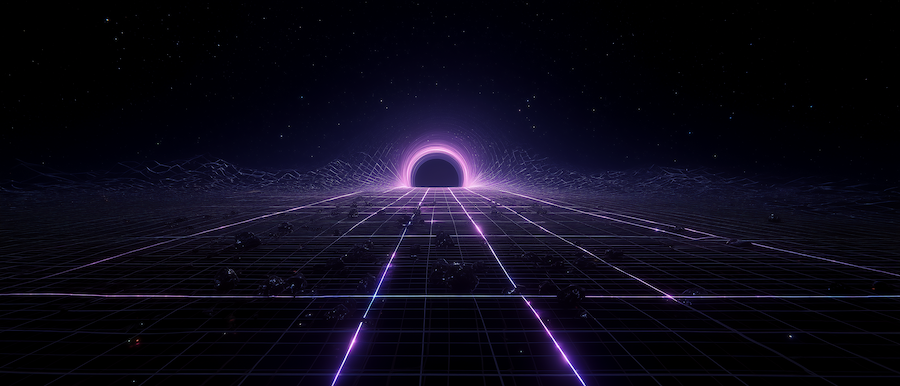
* The picture I like here is to think of a rocket that is falling towards a black hole, it can't escape but it can try to fight it. As it uses its thrusters it falls a little slower towards the black hole (moving through space), this movement through space slows down the speed at which it moves through time (falling towards the black hole), but ultimately it is still mostly moving through time / falling, and will reach its end.
The Eye in the Thread
If the block contains every branch of time, why does your experience trace only one of them?
This is one of the active problems in foundations of quantum mechanics, and it has a name: self-locating uncertainty. The idea was developed by Lev Vaidman in the 1990s and later formalized by Sean Carroll and Charles Sebens. Their argument: at every branch point in the wave-function, all outcomes occur. Both “copies” of you are equally real. But before you observe the outcome, there’s a genuine question of self-location — which copy will you wake up as? This isn’t a question about hidden physics. It’s an indexical question, like asking “which near-identical room am I in?” Both rooms exist. Both copies of you exist. But you, from the first person, are in one.
Carroll and Sebens used this framework to derive the Born rule — the rule that says the probability of finding yourself in a given branch is proportional to the squared amplitude of that branch. This is significant because it means your experience of a single thread through the multiverse isn’t arbitrary. It’s statistically weighted by the actual quantum mechanical amplitudes. The physics determines the probability of which path you find yourself on, even though all paths exist.
Being in a particular branch of time is not the same as selecting which branch of time you are in. There isn’t any “you” necessary to select a branch at a fork in time, and no metaphysical you is necessary to stand above the wave-function and make a decision. There is just the indexical fact that any conscious observer, embedded in the block, finds themselves tracing one continuous thread through the branching structure. There are real problems in the scientific models and science as soon as you try to talk about entities, you/me, “picking” pathways through time. But if we talk instead about which timeline you occupy, as a matter of fact, then all those problems go away. Consciousness is not selecting an outcome. The wave-function still evolves deterministically. All branches still exist.
The only thing being added is the indexical fact that subjective experience is one-dimensional. The full block is multi-dimensional. The line you trace through it is one.
When people hear about many-worlds there is this source of confusion that often arises and makes it feel false. The intuition that “I might end up in any branch” feels like a violation of causality, but it isn’t. All branches happen. You, the “indexical observer”, happen to be on one of them, weighted by the Born rule. The structure all exists. The thread is yours.
Rivers of Least Action
Why does our thread feel so coherent? Why don’t you find yourself, mid-sentence, suddenly transported to a different body in a different century? The block contains those branches. The Born rule weights them.
What is it about your experience that hugs so close to a continuous, sensible line? The answer comes from the same physics we touched on in our previous article, when we talked about photons exploring every possible path and us perceiving only the one of stationary action. The principle of least action governs single particle trajectories. The same intuition extends, with some care, to threads through the multiverse.
If you combine block time and the multiverse, you end up with a topology of time that looks very different from a single line. Instead of one linear time that everyone is moving along, which creates paradoxes when you disrupt causality, you have time moving along pathways of least action, like rivers through a multiverse. The most predictable continuations of timelines are like rivers that pull things, like you, along these lines through a higher-dimensional time-surface, and your experience of time ends up being one-dimensional because it is the line you trace through the fabric of time, not necessarily because time itself is linear.
The river is wide and deep along the broad central current. The branches where you remain you, in this room, reading this sentence, with a coherent memory of yesterday, are overwhelmingly weighted by the Born rule. They form the main channel.
Forks in the river
Uncertainty exists at all scales. Chaos principles are real, and they affect systems large and small. So while time may be converging on many ribbons of least-action pathways, it is also diverging in many other places, like drops of water that hit a split in the river. Some go left, some go right.
If you were to map all the possible ways your life could go from start to end, you would end up with something that looks like the branches of a river, splitting off and converging back again at various points across spacetime. The line you draw is a pathway along one of the countless strands your experience can bring you along, but it is still bounded by the constraints of probability. The laws of least action apply to the small. They also apply to the macro world we live in.
The principle of least action describes single particle trajectories, where the path between two points is the one along which the action is stationary. The Born rule describes the probability distribution over which branch of the multiverse an observer finds themselves on. While these are not the same equation and they do not describe the same kind of object, the intuition behind them is structurally similar. Most threads through the multiverse, weighted by amplitude, are coherent continuations. The exotic ones exist but they are vanishingly improbable. The river of probable continuations is what supplies the felt coherence of being you.
That gets us to the question of what being you is actually doing inside this river.
Life as a Fourier Series
In the last article we also started talking about oscillations. Everything oscillates and all physics can be deconstructed into oscillations. If you wanted something fundamental about our universe, it is just that, things move in cycles.
A Fourier series is a deconstruction of something into a series of these oscillations. You can decompose a sound into a series of simple sound waves, but you can even deconstruct a complex line drawing of a person’s face into a series of oscillations too. (The video below is a great visual breakdown of this process.)
https://www.youtube.com/embed/r6sGWTCMz2k?feature=oembed
The image to hold onto is this: a pendulum, set in motion at a starting position, traces a complex line through space as it swings. Your life, viewed from the block, is something like that line. The initial conditions are set, the forces are in motion, and a line gets drawn from start to end. You witness it from the inside.
While it might imply I am suggesting everything becomes mechanical, indeterminism survives because:
The first is branch self-location itself. Even in a fully deterministic Everettian block, you cannot know in advance which branch you will find yourself on after a quantum measurement. This isn’t ignorance of a hidden variable. It is a structural feature of being an observer inside a branching structure. The Born rule weights are real, but they don’t determine outcomes for any single observer. The indeterminism here is indexical. Not about what happens globally, but about where in the block a given experiential thread is located.
The second is quantum vacuum fluctuations and the cosmological initial conditions. In inflationary models, the density perturbations that seeded all large-scale structure — galaxies, planets, the mountains and buildings — originated in quantum vacuum fluctuations during inflation. These were amplified into classical structure later, but their origin was genuinely indeterminate in the quantum sense. The pendulum’s starting position was not set by prior classical causes “all the way down” because at the bottom is the quantum field, which is the purest chaos we know. The very initial conditions of the line were stochastically generated.
Third, as the pendulum moves, it becomes harder and harder to predict the future path it will take. Take asteroids for example, we can map out their trajectory for about 100 years, but after that very small deviations in angle start to cause enormous ranges of outcomes and then what started off as predictable becomes chaotic. Our lives viewed from this perspective of the starting pendulum might start off looking predictable, but then rapidly flow into what seems like chaos if we were to predict, from the release, where we actually end up. (And given that we are entering as helpless babies into a world largely driven by the decisions of others, that predictable period might be incredibly short.) Short intervals stay tractable, the way your near term Tuesday usually resembles your last Tuesday, but the further out you try to predict, the more the chaos compounds.
So the picture is not pure mechanism. The mathematics is deterministic, but the initial conditions, the branch you find yourself on, and the direction of the tracing all have genuine indeterminate elements. What’s gone is the idea that you are the source of the indeterminism. The indeterminism is in the structure. You are the witness.
The Free Will Question

If the structure is fixed, the thread you are on is an indexical question, and the indeterminism lives in the boundary conditions rather than in you, what happens to free will?
First of all, I feel we need to define terms. When people say “free will” it potentially hides two very different things, and confusing them is what makes this question so slippery.
The first kind of “free will” is the kind your brain does. A human brain gathers information, weighs options, simulates outcomes, and produces decisions. That is real. That is what brains do, and a thermostat doesn’t do it. When I say “free will” in this everyday sense, I mean exactly that capacity. It survives untouched in this picture.
The second kind is what philosophers call libertarian free will: the idea that there is an immaterial you, outside the causal order of physics, that reaches into the world from your awareness and nudges neurons toward decisions. This is the “you” as captain of the ship, the witness who is also the chooser. This is the kind of free will I am calling into question.
The two are very different claims, and most of the confusion in free will debates comes from the unintentional sliding between them.
For the libertarian kind, the honest position is that no experiment has ever demonstrated it, and the experimental work we do have cuts against it. Benjamin Libet’s experiments * in the 1980s found that the neural activity associated with a decision begins measurably before the conscious experience of having decided. More recent work has pushed this further: brain scans can predict simple choices several seconds before the subject reports being aware of having made them (Soon et al., 2008). Whatever is choosing inside your skull, it is not your conscious self. Your conscious self is informed of the choice after the fact and then constructs a narrative in which it was the one doing the choosing.
* (It's worth flagging that the Libet result is not as airtight as it once seemed. Aaron Schurger's 2012 work reinterpreted the famous "readiness potential" as a stochastic accumulator effect rather than evidence of an unconscious decision being made early. That weakens the strong claim "Libet disproved free will." It does not, however, restore libertarian free will. It just makes the neuroscience less of a knockout blow and more of a piece of converging evidence.)
What survives all of this is something like Daniel Dennett’s position in Freedom Evolves (2003): what’s worth saving from “free will” is the capacity to deliberate, respond to reasons, and modify yourself based on feedback. That capacity is real. It’s what brains do. Compatibilism doesn’t restore libertarian free will. But it does preserve what most people actually mean when they talk about responsibility, choice, and the value of deliberation. The witness framing and compatibilism aren’t in conflict. The witness witnesses. The brain deliberates. Both are true.
But this is not the same as saying the future is predetermined. If the topology of time is not linear, and you move through that topology, it does not mean that you are guaranteed to move down one very specific pathway of that fabric without any potential for uncertainty. Systems can be uncertain while also not allowing the agents, or the elements that move through them, to exert will over how that system behaves.
Human bodies, and their brains that have thoughts and feelings, are not disconnected from the world that is moving through this higher-dimensional fabric. They are as much a part of it as the rocks, the other people who are not you, the news you read, and the sun in your eye. Some of the choices those bodies make are so predictable they seem like destiny. Others are built on a chaotic under layer, the quantum field, the firing of neurons, the unpredictable world outside. Determinism and chaos intertwine within and without us. Our pathways through the world are a mixture of probability weighting and genuine indeterminacy at the branch points.
The only true thing I think you can say about your and my experience is that we observe time, and we observe experienced moments. We observe our minds making choices, which occur but the observer cannot actually influence them. When we think a thought, it takes time for that thought to propagate. If you make a decision, the time it takes for you to make a decision is always from a sub-location in your brain that occurs before you become aware of it. And that location isn’t one place. It is sometimes in multiple places. They bubble up, and then there is a “winner” in the collective, which becomes your cognitive experience: I will watch a video on YouTube now. Observing choice is not the same as choosing. Perhaps our real nature is the passenger aboard our life boats, witnessing our thoughts, bodies, and minds make choices and respond to the world, as we travel along the rivers of time. The ghost in the time-machine.
What’s left, when you remove the immaterial captain, is what was actually doing the work all along: a brain embedded in a body, embedded in a world, embedded in a thread through a multiverse-block, all of it physically continuous with everything else. The “you” that survives this picture is not a chooser. It is an observer of a brain that makes choices and has a strong sense of self identity. Those choices are as thoughtful as the brain can make them, but they abide by physical laws. The witnessing is real, even if the “captaining” was never literal.