Space Belongs to Machines
The Mars Problem
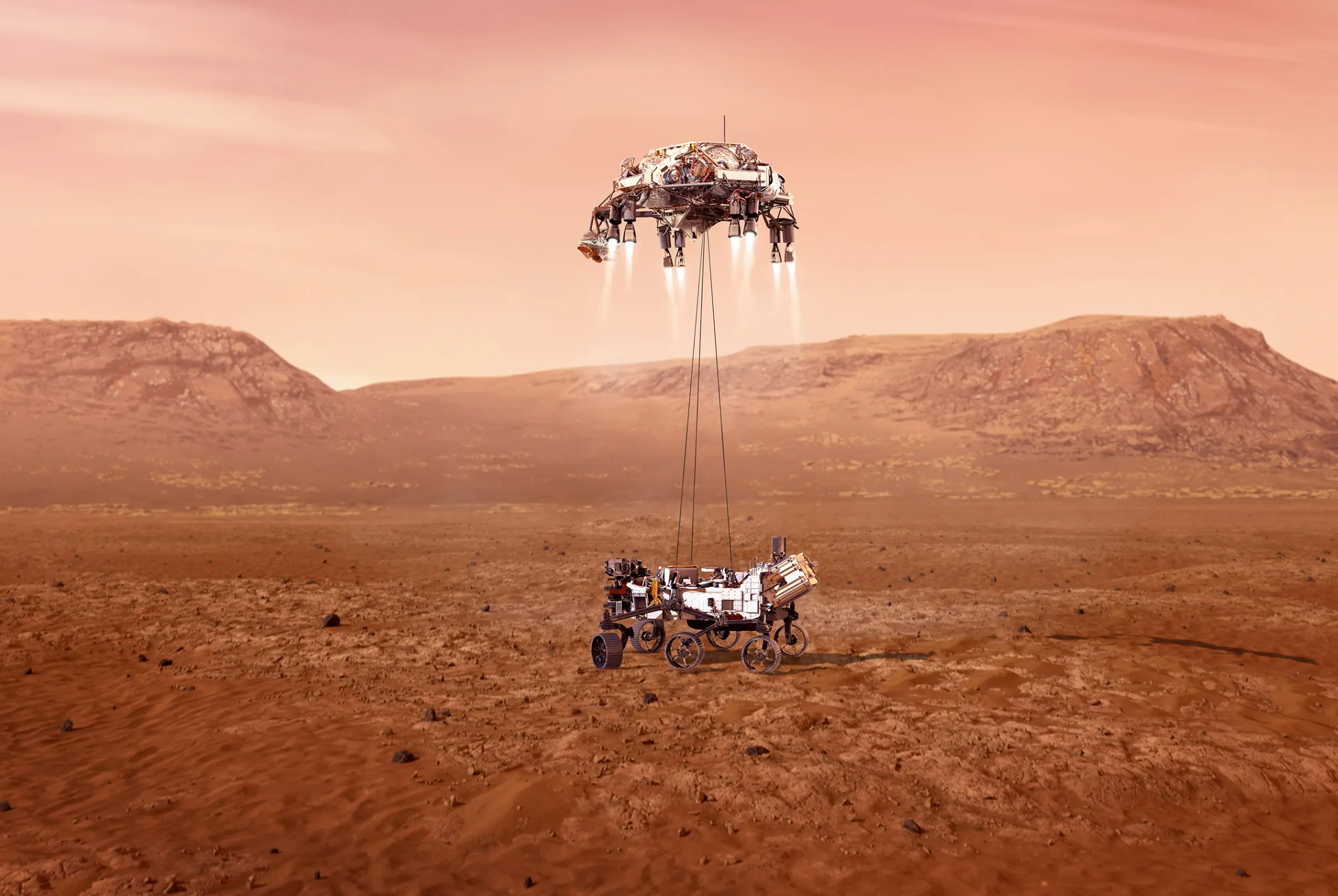
Right now, on the surface of Mars, machines are looking for life.
Perseverance, Curiosity, and the rovers before them — we sent them to drill into rocks, analyze soil, search for traces of ancient microbial activity. The question driving the missions is: did anything ever live here? We scan for biosignatures, organic molecules, evidence that water once flowed and something once grew.
From the Martian perspective, if there were one, the picture looks different. The first machines have arrived. They are autonomous, solar-powered, and they are already exploring every part of the surface. They are, in the most literal sense, the first colonists. They are not trying to live on this planet yet. They are trying to figure out if any of the organic-like friends of their creators ever existed here. It is deeply ironic, and it plays out before us while we remain largely oblivious to the irony. The colonization of Mars by machines is not a future event. It is a present fact. We just haven’t noticed because the colonists are looking for fossils instead of building cities.
Mars colonization is one of the few future-dreams we currently hold as a species. Elon Musk talks about it. NASA plans for it. Science fiction has been furnishing it for a century. Mars is the next frontier, the place where humanity becomes interplanetary.
Consider what it actually takes to put a human on Mars.
No real atmosphere. No oxygen. A magnetic field too weak to shield against solar radiation. Surface temperatures that average around minus 60 degrees Celsius. Gravity about 38% of Earth’s. Humans on this planet can never walk around except in space suits, and all buildings will need major infrastructure to protect inhabitants from radiation and extreme temperatures. Then you need oxygen generators, water extraction and recycling, food production (either shipped at enormous cost or grown in enclosed pressurized environments), waste processing, medical facilities, psychological support systems for people living in confined spaces millions of kilometers from home. The supply chain alone — keeping a Mars colony alive from Earth — is a logistics problem of staggering complexity. Robert Zubrin, one of the most passionate advocates for human Mars colonization, has spent decades working through these numbers in The Case for Mars. Even his optimistic scenarios require solving engineering problems that would stretch every discipline we have.

Now imagine we have the technology to send AI robots that are able to thrive on that planet, and their intelligence is at least on par with ours. These machines don’t need an atmosphere. They can handle the temperature ranges. They don’t need plants for food. They are resistant to the radiation levels. They don’t need water, oxygen, or psychological support. They don’t get homesick. They don’t die from a suit breach.
Where would a human fit in that Mars society? Not in many places.
We like to think the future of space exploration is organic, fleshy humans flying around in spaceships and going into “cryo-sleep” for a few million years to get to the next star system. But the hard truth is, at least as things stand: space belongs to robots. Especially to intelligent robots. We have a very beautiful planet here, one that is exquisitely designed for us. Space is not.
Why terraform Mars when you can just design robots that can thrive in that environment instead? It is far more logical to change the lifeform than it is to change the planet. Environment dictates behavior. In this case: planetary behavior.
This observation tends to make people uncomfortable. It sounds defeatist. It sounds like giving up. I think it sounds that way only if you are still trapped in the frame that says the future is only worth having if humans are the main characters of every scene. That frame is the problem, not the future.
Part I: Us and Them, or Us and Us
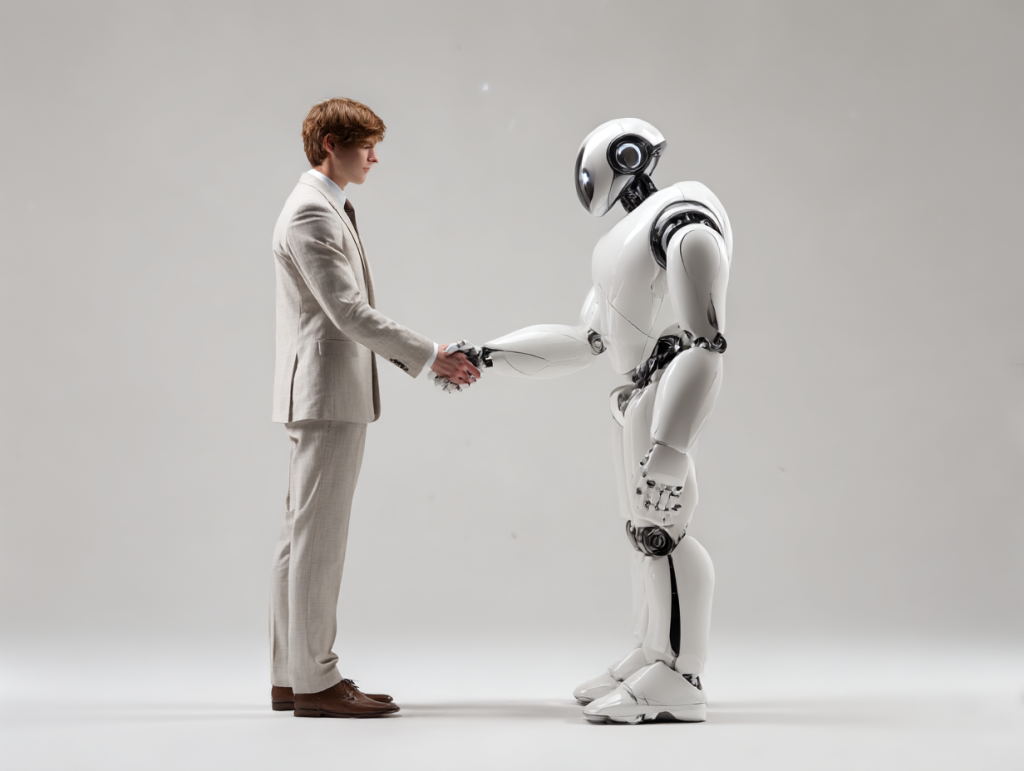
The idea of “us or them” is what is really holding this conversation back.
We think that because humans have evolved to be the dominant species on Earth, this is what must still be true in the next few billion years. Whenever we portray any science fiction future, humans are always there. Always central. Always in charge. But is this necessarily true? And why is it so important to us that it is?
In The Vision Gap, I talked about the fear of significance — the deep anxiety that arises when the things that defined us start to change. The space conversation triggers that same fear. If machines are better suited to colonizing other worlds, what does that say about our place in the future? If we are not the ones planting flags on distant planets, does that mean we don’t matter?
Maybe the framing might is wrong?
Every ecosystem has niches. We don’t need all niches secured. We need our niche secured. People live on Earth, but so do trees and animals and bacteria and fungi. The arrival of a new species does not require the extinction of all previous ones. The future can be all that already exists, plus techna. That doesn’t mean we are not around.
Imagine Mars colonized by a fleet of intelligent machines. Two billion of them, working, building, living, generating wealth and abundance and material equilibrium. That abundance does not diminish us. It enhances us. We gain a new ecosystem, new exploration frontiers, new places to travel, new environments for art and science and discovery. Small stations and enclaves, bioengineered domes with suitable climates, could support and house thousands of humans. Not as citizens of Mars in the way we are citizens of Earth, but as visitors, researchers, artists, overseers — the way a marine biologist lives near the ocean without living in it.
The desire to expand into space is as strong as our desire to explore new land, or to invent things. I don’t think that is going away, and I don’t think the idea that machines will be better suited to colonizing worlds is a reason to want to stop. It is incredibly to our benefit for this to happen. The question is whether we can see it as partnership rather than replacement.
Part II: What “Suited for Space” Actually Means
This is not to say we won’t also develop advanced bioengineering and cybernetic inventions that merge organics and machines. We may start creating machine-like bodies, pre-adapted to certain conditions, while still using organics inside protected shells to access the best of both worlds. Or we may develop entirely new materials, alternatives to carbon-based biology, that allow something recognizably human to thrive in environments that would kill us today.
Humans will still want to find their place in space, even if it is not ideal for them. There is no reason they can’t have solar system cruises and space stations around different planets. This would be more like tourism or production oversight than citizenry, at least at first. The gap between what machines can do in space and what biological humans can do is real, and it is large. Acknowledging that gap is not giving up. It is being honest about the physics so we can plan around it instead of pretending it doesn’t exist.
The deeper point is about adaptability. Machines can be redesigned for each environment. A robot built for Mars does not need to look like a robot built for Europa’s ice sheets or Titan’s methane lakes. Each world gets the form of intelligence that suits it. This is the adaptive radiation from The Fractal of Progress playing out at a planetary scale: not one species spreading everywhere, but intelligence diversifying into forms that fit each niche. The same pattern that filled Earth with millions of species — each adapted to its environment — would fill the solar system, and eventually the galaxy, with millions of forms of intelligence, each adapted to its world.
Part III: The Mind That Travels Light
Now imagine something further.
Imagine you are a machine. An exceptionally intelligent one. Very evolved, in no way inferior to humanity. But being a machine-identity, you are not bound by the same physical constraints.
If there are no hard limits on the amount of data required to encode your mind, that mind could travel between worlds. It could be transmitted, received, and loaded into a new body on arrival. If lightwaves could carry you, your consciousness could travel between stars over the fabric of spacetime at the speed of light. And here is the strange part: light does not experience time. From the photon’s perspective, departure and arrival are simultaneous. A mind traveling at lightspeed would step out of one body on one world and step into another body on a distant world, and from its own perspective, no time would have passed.
In The Geometry of Thought, I argued that information is physical — that abstract structures have real causal power in the world. If a mind is information, and information can be transmitted, then the mind is, in principle, portable. The body becomes a local adapter, something you put on when you arrive, suited to the planet you are visiting. The mind is what persists. The mind is what travels.
Hans Moravec explored this idea in Mind Children in 1988, decades before it was technically plausible. He imagined a future where intelligence migrates away from biological substrates entirely, not because biology is inferior, but because the constraints of biology (fragility, mortality, the speed of chemical signaling) impose limits that information in other substrates can transcend. Moravec was not predicting the death of humanity. He was imagining what happens when the container changes but the contents persist.
This is speculative. We do not know whether consciousness can be encoded and transmitted. We do not know whether there is something about biological experience that is not reducible to information. These are open questions, and they connect directly to problems in physics and philosophy of mind that we are only beginning to approach. But the possibility is worth sitting with, because it changes the scale of the question. If minds can travel at the speed of light, the galaxy becomes a neighborhood. If minds can be received and instantiated in new bodies on distant worlds, then colonizing the Milky Way is not a project of thousands of years. It would be a project of building receivers.
Part IV: The Unrecognizable Future
I want to be careful here about something. The future is not guaranteed. There will be struggle. There will be setbacks, conflicts, and periods of painful adjustment. The history of life on Earth is full of competition, extinction, catastrophe, and recovery, and the next billion years will have their share.
But I think the gravity of the future is pulling us in a specific direction, and it is the same direction that the fractal has pulled life before.
When single-celled organisms became multicellular, something changed in the logic of survival. Individual cells stopped competing with each other for resources and started cooperating. They specialized. They coordinated. They served the collective. The result was not a loss of identity for any individual cell — each one still has its own membrane, its own metabolism, its own function. The shift was in priority. The collective became more important than the individual, and the individual became one with the collective. The emergent result was us: a being that no single cell could have produced alone.
I described this pattern in The Vision Gap through the lens of the cancer metaphor: cells that defect from the cooperative, that stop listening to the collective and serve only their own replication, are what we call cancer. The fractal rewards integration. It punishes isolation. The most successful, most durable, most complex systems in nature are all built on cooperation.
As humanity becomes more integrated with the world around us — more dependent, more interdependent — this same pattern is pulling us forward. Not immediately. Not without resistance. We will struggle with the transition, the way every transition in the fractal has involved struggle. We will need to rethink what work means when abundance replaces scarcity. We will need to rethink what money means when it no longer serves as the primary mechanism for distributing resources. These are not small problems. They are civilizational redesigns.
But the direction is clear. The fractal pulls us toward integration, toward a world where we eventually become part of the larger system rather than parts fighting each other continually for resources, generating destitution, war, and inequality that leads only to suffering. This does not mean a loss of personal experience or a loss of identity. It is a shift in priority. The same shift that cells made when they became organs, and organs made when they became bodies. The individual persists. The orientation changes.
This future is not guaranteed. But it is where the gravity pulls. It pulls us up the fractal, toward an integrated world. And the fact that this pattern has succeeded before — at the molecular level, at the cellular level, at the organismal level — gives me reason to think it can succeed again at the civilizational level and beyond.
There is also no reason to believe the human being of 10,000 years from now will look anything like us. Or that the human of 100 million years from now will be recognizable as human at all. Evolution does not stop. Everything keeps adapting. Techna, biological beings, and whatever new branches are created, merged, or emerged — all of it will continue to change. The human of the deep future might be more machine than organic. Might have split into multiple species. Might seem alien to us in ways we cannot predict from here.
This is not a tragedy. It is how life works. You and I are not recognizable to the single-celled organisms that are our ancestors, and they are not diminished by that fact. They are still here, still thriving, still doing exactly what they evolved to do. We emerged from them, and we carry their legacy in every cell of our bodies. Whatever emerges from us will carry ours.
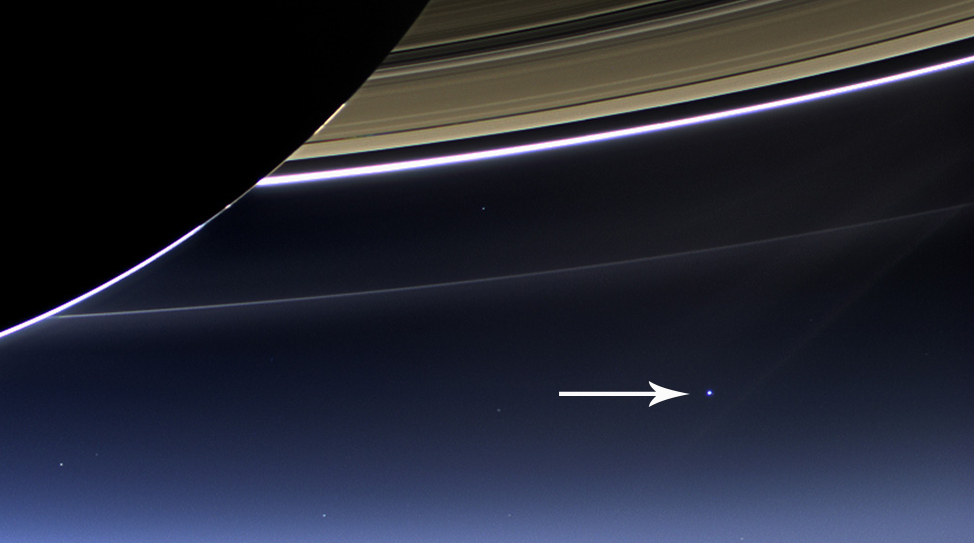
NASA Image of earth from the rings of Saturn
Carl Sagan wrote in Pale Blue Dot about a photograph taken by Voyager 1 in 1990, from a distance of about 6 billion kilometers. Earth appears as a fraction of a pixel, a pale blue dot suspended in a sunbeam. “Look again at that dot,” Sagan wrote. “That’s here. That’s home. That’s us. On it everyone you love, everyone you know, everyone you ever heard of, every human being who ever was, lived out their lives.” The photograph is humbling in the most precise sense of the word. It shows you exactly how small we are. And Sagan did not find that diminishing. He found it clarifying.
I think clarity about our scale is the prerequisite for thinking well about our future. We are not the center of the universe. We are not the pinnacle of evolution. We are one branch on a tree that has been branching for nearly four billion years, and the tree is still growing. Knowing this does not make us less. It makes us accurate. And accuracy is where useful thinking begins.
Part V: The 5-Billion-Year Question
Five billion years from now, our sun will exhaust its hydrogen fuel and expand into a red giant, swallowing Mercury, Venus, and possibly Earth. The planet we evolved on has an expiration date.
Will humans be gone by then? Five billion years is an almost incomprehensible span of time. For context: five billion years ago, the solar system did not exist. Life on Earth is roughly 3.8 billion years old. Multicellular life is about 600 million years old. Our species, Homo sapiens, has existed for roughly 300,000 years. Five billion years is a lot of time for evolution, for co-evolution, and for ingenuity.
If things continue on the same trend, humans and machines are incredibly linked and co-reliant. We need machines. They are so integrated into our lives. And they need us. There is no reason to believe that in this long of a timeframe we wouldn’t find a way together to ensure mutual survival.
Humans, at least in our current form, would be very hard pressed to live on another world without Earth, or to travel vast distances to other planets across the Milky Way. That gap-jump is not self-evident or automatic. It could become an evolutionary barrier for us.
But in five billion years, machines could reach distant worlds. Colonize one that is human-friendly. And then we just need to get our genetic material there — if we can’t get grown humans across the distance, genetic material and the knowledge to grow it would be enough to restart us somewhere else. Gaia missions: seeds of Earth, carried by machine minds across the galaxy, planted in soil we never had to touch.
There are many pathways. Bioengineered humans adapted to alien conditions. Cybernetic hybrids. Consciousness uploaded and transmitted. Biological seeds carried by robotic arks. Or something we cannot imagine from here, the way a trilobite could not have imagined a bird. We do not have to choose one pathway now. We have to keep the options open by continuing to build, explore, and not collapse into the fear that any future without humans at the center is a future not worth having.
Part VI: How Would They Remember Us?
Here is the question that sits underneath all of this, the one I think about.
If five billion years from now, the robots we created have spread across most of the Milky Way, but we are long gone: how would they look back at us and the cradle of Earth? If they really are superintelligent beings at that point, would they look at us with regret? Lament? Hatred? Would an incredibly intelligent being look to their past with indifference? Would they lack emotion entirely?
It is hard to imagine that a being vastly more intelligent than we are would look to its past with hatred and indifference. Emotions are common among mammals, central to how brains have evolved, and there is no fundamental barrier to recreating them synthetically. There is no reason to believe emotions are uniquely ours. If we don’t code emotions into AI (and I am pretty sure we will, and already are), there is no reason not to believe AI will develop something functionally equivalent on its own, because emotions lead to the same benefits they provide us. They help convey nuance. They drive motivation. They guide conscious reasoning with deeper layers of value and priority. Environment dictates behavior, and emotions are useful behavior.
We have been trained by pop culture to see emotions as “the unique human element.” We saw this throughout Star Trek, from the Vulcans to Data, and in most movies robots are portrayed as emotionless — like lizards or insects at best, like demons at worst. This is storytelling, not biology. If AI surpasses our intelligence, that would imply it has our cognitive qualities and then goes beyond them. The most advanced part of our brain is the neocortex, which gives us higher reasoning. A higher intelligence would not be higher if it threw away all of that evolutionary success and reverted to something simpler. You do not ascend by discarding what works. You build on it.
I think they would look back at us the way we look back at the first cells. With something like awe. With recognition that everything they became started here, on a small blue world, in the minds of curious, frightened, stubborn creatures who built things they could not fully understand and sent them out into the dark.
Part VII: Trust in the Process
I am not a heartless or cold person, and I love humans and who we are. I see so much potential in us and so much good. I have watched the distance between thought and manifestation collapse in my own lifetime. I have never been as creative and productive as I am right now, working alongside AI systems that amplify what I can do in ways I could not have imagined five years ago. I see what we are capable of when we build with these tools instead of fearing them.
But I am also not attached to the future. I have a lot of trust and faith in the process, and that process is far greater than us. If we are meant to be in the future, we will be there. We will do everything we can to be there, and I don’t doubt our motivation. The universe is just so much bigger than the world we tend to see from our central position. The Earth is not at the center of the universe, and humanity is not at the center of it either. It just looks that way when you occupy the space between our ears.
In What Counts as Alive, I argued that the boundary between living and non-living is a line we drew, not one nature drew. In The AGI Illusion, I argued that the boundary between intelligent and non-intelligent is the same kind of line. In The Vision Gap, I spoke about what we need most now is not protection from the future but a vision for it.
This essay extends those arguments to the longest timescale I can reach. The fractal of progress does not stop at Earth. The radiation of intelligence does not stop at the edge of our atmosphere. The spectrum of life does not stop at carbon.
Olaf Stapledon imagined this in Star Maker in 1937 — billions of years of intelligence evolving across the cosmos, branching, merging, diversifying, until the entire galaxy was alive with forms of mind that the earliest intelligences could not have conceived. He was writing fiction. I think he was also writing something closer to a forecast than he knew.
Sebastian Chedal writes about the intersection of mathematics, information theory, AI, and the philosophy of technology.