
Pictures of Time
Years ago I saw an episode on PBS Spacetime that explored the question: “Does the past and future exist?”. It went deep into the following three possible models of time:
- Time is created as it enters the future/present.
- Time pre-exists, and we move through it like a coordinate.
- Only the present exists, which we all share as a common experience.
Counter intuitively, scientists are adamant that the present can’t be universal, and time must already exist before you arrive in it. Meaning time is more akin to a geographic coordinate. In my experience, very few people realize this is the current scientific “norm”. So how did we get here and what are the implications?
Relativity and the Universal “Now”
Many of you know about Einstein and the basics of light speed being universal to each observer, so I will try to be brief on this. The theory goes that the speed of light is the same for every observer, regardless of how fast they are moving. A flashlight pointed forward from a stationary platform and a flashlight pointed forward from a train moving at half the speed of light both emit light that travels at exactly the same speed. There is no addition. There is no subtraction. The number, c, is a constant.
However we usually think this is a fact about “light”, when actually it is a truth about “time”.
When you stand and talk to each other, it takes time for what they say to travel to you, and then time for your brain to process. Nothing around you is in your present-time. This is microscopic at short distances but it is very real when you go out into vast distances, move very fast or are at different gravitational fields.
Furthermore the speed at which your “clock” ticks is never the same as anyone else. Time flows slower for your feet than for your head. If you stand on a box, you are moving faster through time.
What you perceive as happening in your “present” can be in someone else’s past. If you take the example of two trains passing each other at high speeds and someone stationary on a platform, the three of them can have their watches synced at the start but then disagree about the order in which messages or coin flips occurred. To one person messages might arrive at the same time, to another they may stagger and arrive one after the other.
The order in which they arrive isn’t just a perception problem. Even after each observer accounts for the time it takes light to travel and recalculates the order of events accordingly, they will still disagree about the sequence. There is no shared ordering of time that is possible. Each person’s perception of events happens in a unique sequence to them that no one else exactly perceives in the same sequence.
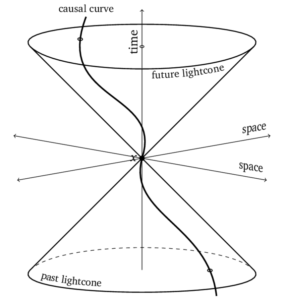
Every event you experience sits inside a structure called a light cone. Your past light cone contains every event that could have sent you a signal. Your future light cone contains every event you could send a signal to. When two people interact, their worldlines pass through each other’s light cones, and information can flow between them. But neither person is ever in the other’s present. Each is always reaching into the other’s past, and sending into the other’s future.
Information takes time to travel, and the clocks at either end of that journey tick at different rates. Meaning if you are on earth and send a message to mars, which takes several minutes to get there, you do not have the same clocks, you are not in the same “present” moment. What is happening instead is information travels through time, reaches you in your local “present” which gives you information about the past, and then you send information out again which arrives in the other person’s past. A shared present moment is not possible in our understanding of physics. Instead physics, specifically general and special relativity talk about time and space being a coordinate. You occupy a specific time-space coordinate, which is unique to you, and you travel through space and time at your unique speed and distance. What is the present is just relative to you and there is no single source of reference that establishes a common “present” moment.
Different ordering of events, different rate at which you move through time, no common present moment.
This is called the relativity of simultaneity. If two observers in relative motion disagree about which events are simultaneous, then “now” is not a property of the universe. It is a property of an observer. Two events that are simultaneous in Alice’s frame are not simultaneous in Bob’s, and there is no test that can determine whose ordering is correct. Every observer carves spacetime into past, present, and future differently. And every carving is equally valid.
In 1966, the philosopher C. W. Rietdijk and, independently, Hilary Putnam in 1967, said that if every observer’s “now” is a valid slice of reality, and those slices disagree about which events are present, then all of those events must already exist. There is no other way to account for it. If Bob’s “now” includes an event that has not yet happened from Alice’s perspective, that event must already exist, in some sense, right now. Otherwise Bob would be perceiving something that isn’t there.
Living in a Block
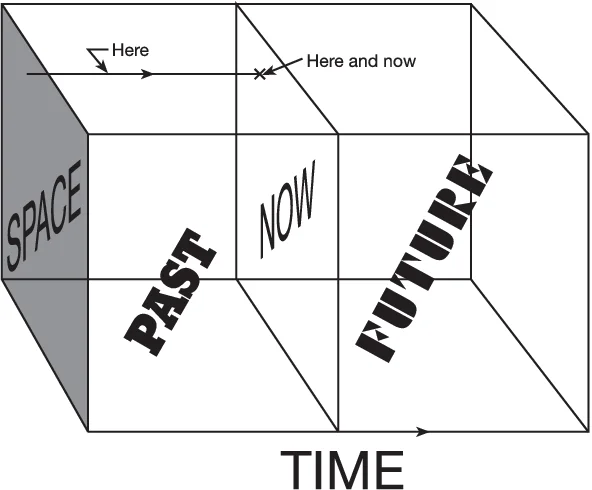
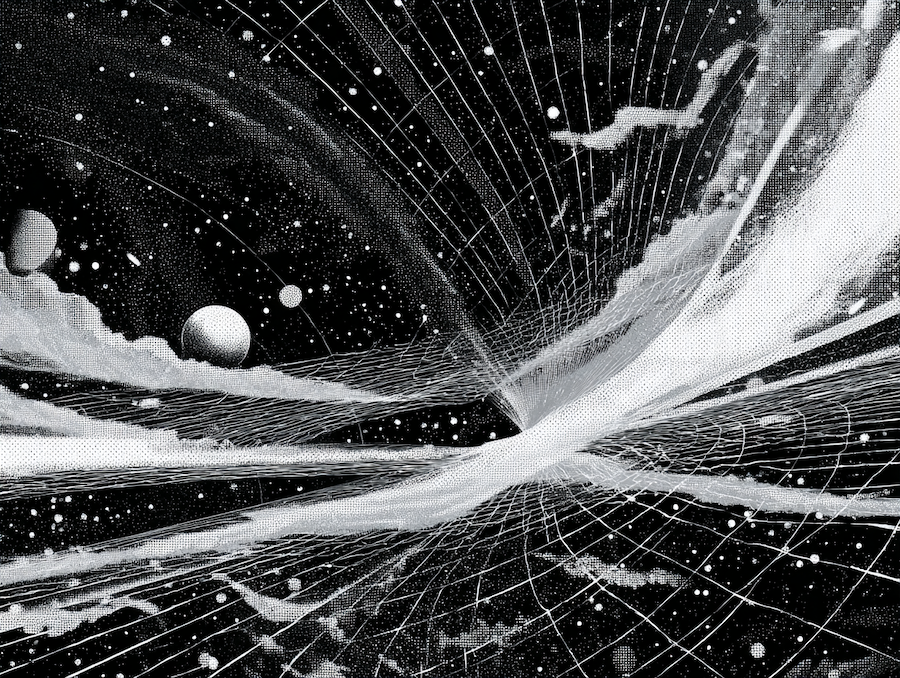
This is the Rietdijk-Putnam argument, and it forces a conclusion that physicists and philosophers call eternalism or block time: all moments, past, present, and future, must exist with equal reality. The universe is not a three-dimensional space evolving through one-dimensional time. It is a four-dimensional structure where every event sits at its own coordinate. What we feel as “flow” is something that happens inside the “block”, not to it.
To be clear, I do not mean to imply that block time means the universe is somehow “frozen”. It means time has the same status as the three spatial dimensions. Past and future are places, not times yet to happen or times that have happened. Your morning coffee is at a coordinate. So is your last conversation with your grandmother. The times you spend at the beach are a “place”. So is whatever you will be doing on Thursday.
Three Models of Time
To take block time seriously we have to take its rivals seriously first. Eternalism, another way of thinking of block time, is one of three serious philosophical positions about the nature of time. The other two are presentism and the growing block.
Presentism is the position most people hold without realizing they hold it. It says only the present moment is real. The past existed but doesn’t anymore. The future will exist but doesn’t yet. Reality is a knife-edge of now moving forward into nothingness. This is the most natural picture you absorb just by being alive. It maps so cleanly onto experience that it feels like it has to be true.
The growing block position is a compromise. The growing block postulates that the past and present are real but the future is open and unwritten. The universe is constantly accreting new “reality” at the leading edge, like a wave building from behind.
Both views require something that physics sadly took away in 1905. They require a universal, shared now. A single slice of reality that everyone agrees is the present. Presentism needs it because if only the present is real, there has to be a fact of the matter about which slice counts as “now”. The growing block needs it because someone has to be doing the growing, and the leading edge of the universe has to be at some specific shared moment.
Einstein’s relativity says there is no such slice. Different observers carve the universe differently, and no test can decide whose carving is the right one. If you commit to presentism and try to specify which events are real now, you immediately run into the above problems of non-local time. Two people’s definitions of “the present” overlap but do not match, and there is no third perspective that arbitrates.
The growing block has the same problem in a slightly different form. If the universe is constantly adding new reality at the edge, where is the edge? At Alice’s “now” or Bob’s “now”? They are not the same point in spacetime. If you pick one, you have privileged a frame. If you say “both,” you have collapsed back into eternalism (time is just a geographic coordinate), because their union covers a range of events that all have to be valid.
This is not a knockdown argument that presentism or the growing block is impossible. Philosophers have constructed clever versions that try to wriggle out of Einstein’s relativity by positing hidden reference frames, preferred foliations of spacetime, or new physics yet to be discovered. However, none of those proposals is provable or has survived contact with experimentation. Block time, by contrast, demands nothing new. It is simply the natural reading of relativity, and every test of relativity in the last century has been fully consistent with it.
The reason eternalism is the working model in physics is not that physicists have a metaphysical preference for it. It is that all the alternatives keep being falsified. Eternalism is what is left when everything else has been ruled out.
Time From Timeless Things
Block time tells us that all moments exist as coordinates in a four-dimensional structure. But this leaves a question unanswered: if the block is timeless from the outside, how does time arise inside it?
The fundamental equations of quantum gravity, in their simplest form (the Wheeler-DeWitt equation), don’t contain time at all. The universe, at its deepest level, looks like a timeless mathematical object.
Everything in the universe can be reduced down to oscillations. Every physics equation you have ever learned is just a stack of oscillations added up together. Light is an oscillation of electromagnetic fields. Matter is a standing wave of quantum fields. Sound is an oscillation of air. Heat is the oscillation of molecules. The universe, at every scale, is made of things that vibrate.
Our current understanding is that time itself is created from trapped oscillation around a fixed point. Stuck loops form higher-order loops, and those form higher-order oscillations, as the hierarchy stacks upward through the microcosm into macroscopic space. A photon traveling freely through space has no internal repetition; it experiences no time. Lock that same kind of oscillation into a closed structure, force it to repeat, and something new appears. Repetition. And repetition is the seed of time. The clock is born.
This is what scientists name the process of emergent time. The geography is there. The clock is what lets a thread inside the geography count its position.
Two strands of modern physics formalize this intuition. The first is the Page-Wootters mechanism, sketched by Don Page and William Wootters in 1983 and demonstrated experimentally by Moreva and colleagues in 2014. Their proposal: time is relational. There is no cosmic clock. When two quantum systems are entangled, one can act as a clock for the other. The “time” experienced by one subsystem is just a description of how it is correlated with the state of another. Take away the entanglement and there is no time. Add more correlations and you get more temporal structure.
The second is Carlo Rovelli’s thermal time hypothesis. Rovelli argues that the direction of time, the arrow that points from intact cups to broken ones and never back, comes from the thermodynamic properties of macroscopic systems. Entropy increases. The asymmetry we feel as “time flowing forward” is the universe’s information content rearranging itself in the direction of greater disorder. Rovelli developed this in The Order of Time, and it pairs cleanly with Page-Wootters: one explains how time exists at all, the other explains why it has a direction.
Both pictures point at the same insight. Time is what interactions produce. No interaction, no time. More interaction, more time. The universe is not a stage on which interactions happen; interactions are how the stage gets built.
The intensity of your subjective experience of time may be linked to the density of interactions in your mind. A mouse’s heart beats ten times faster than yours, its metabolism runs hotter, its synapses fire denser. A mouse may, in some real sense, experience more moments per second than you do.

Thermal time
If subjective time depends on the density of interactions in a mind, perhaps something analogous is true at the cosmic scale. Some physicists, including Carlo Rovelli, suggest that the felt flow of time itself may be a thermodynamic phenomenon, emerging from the statistics of vast numbers of interacting particles rather than being a fundamental feature of spacetime.
The ‘production of time’ in the furious density of the early universe, or deep in the centers of stars, may run at a far greater rate than the production of time on Earth. And in the cold of deep space, or the heat-death of the far future, where almost no interactions remain, the production of time may simply cease, leaving behind a spacetime where time as a coordinate still exists but time as a phenomenon does not. Time, in this view, is something the universe produces by being busy with itself. When the busyness ends, time as we know it ends with it.
Measuring the Future
It has been incredibly popular in pop culture to think that “observation creates reality”. So many books have been written that spin off of this idea. “Be here now” and “the power of now.” – But what most people don’t realize is that this interpretation is no longer the dominant view among physicists.
The idea behind “observation creates reality” goes back to the idea that quantum particles don’t have definite properties until they are observed. We say: “The act of observation collapses the wavefunction and creates reality”. This is the Copenhagen interpretation, articulated by Niels Bohr, Werner Heisenberg, and others back a hundred+ years ago in the 1920s, in Copenhagen (hence the name). It is the version of quantum mechanics that made it into pop culture, and into self-help books about manifesting your reality.
Most physicists today regard Copenhagen as an old placeholder, not the final answer. It turns out it has at least one serious problem. It posits a special role for the observer without saying what counts as an observer or when, exactly, the collapse happens. Is a measuring device enough? Does a cat count? Does a conscious mind? The interpretation has been silent on this in a way that bothered people for a century.
The natural follow-up question is: what if the particle did have a definite property all along, and we just didn’t know what it was? When two entangled particles fly apart and one is measured as “spin up” and the other as “spin down,” what if they were always up and down, like a pair of marbles secretly preassigned in advance, and the only mystery is our ignorance?
This view is called local hidden variables. It is the most intuitive alternative to Copenhagen. It removes all the weirdness. It makes entanglement no stranger than mailing one red marble to your friend in Japan and one green marble to your friend in Brazil and being unsurprised that when one of them opens their envelope, they can predict the other.
In 1964, the physicist John Bell proved that local hidden variables, if they exist, must satisfy a specific mathematical inequality. Quantum mechanics predicts that this inequality will be violated. Alain Aspect in the early 1980s, ran experiments whose results consistently matched quantum mechanics and they violated the Bell inequalities.
For decades we tried to think through “loopholes” in the experimental designs, ways a hidden-variable theory might have still snuck through, but in 2015 three independent teams (Hensen and colleagues in the Netherlands, Giustina and colleagues in Vienna, Shalm and colleagues at NIST) finally ran loophole-proof Bell tests with overwhelming statistical confidence. In 2023 the result was reproduced with superconducting circuits. The net result is that the idea of local hidden variables is dead. The intuitive picture, where particles secretly know what they are going to be measured as, is just wrong. That’s not how the universe works.
The only interpretations of quantum reality that have survived experimentation now are nonlocal ones. The most popular among these is many-worlds, in which every quantum measurement splits reality into branches where each possible outcome is realized.
We will go a lot deeper into the many-worlds interpretation and what it implies in subsequent articles, but for now what matters in relation to block-time is that: observation does not create reality. In all our surviving quantum interpretations, the structures of the wavefunction, including the outcomes of measurements that haven’t happened yet from your perspective, are already there. Many-worlds says all the branches of time are real.
Relativity tells us all moments exist. Quantum mechanics, properly interpreted, tells us all outcomes exist in some form. Both lines of physics agree that the structure is there before anyone looks at it. The looking is what locates you inside the structure. It is not what the structure is built from.
The Timeless Substrate
Block time has a satisfying corollary. The thing that has no time of its own, is what gives everything else its time.
Light traveling freely through space experiences zero proper time. From the photon’s own frame of reference (if it could even be said to have one), the moment of its emission and the moment of its absorption are the same moment. A photon emitted by a star eight billion years ago and absorbed by your retina tonight has, by its own internal accounting, traveled instantaneously. This is not a paradox, it is what the equations of relativity say a massless particle moving at the speed of light (c) experiences.
The fact that light experiences no time, but moves through time, and creates time, is hard to reconcile. From the perspective of a photon, the moment it is created and the moment it reaches your eye are the same moment. Light does not really travel, because it is timeless. It is simply absorbed somewhere along the path of least action, after exploring every possible direction it could have taken (mind twisting, but true). We think light travels in straight lines, but it actually explores every path, and we perceive a straight one because that is the path where the action is lowest. This is Feynman’s sum-over-histories, and the foundation of quantum electrodynamics.
The transition from timeless to time-bearing happens when light gets caught. Our reality rests upon a field that scientists call the Higgs field, which permeates all of space. A particle that does not couple to it, like a photon, has no mass, no rest frame, and no time. Its motion through spacetime is purely spatial, all of c pointed into the space dimensions, none into time. From the photon’s perspective, no time elapses between its birth and its death.
When a particle couples to the Higgs, its motion through spacetime essentially rotates. Some of the c that was pointed purely through the dimensions of space tilts into the dimensions of time. The particle gains the ability to be at rest, which is the ability to point its entire motion through time rather than through space. Mass, in this picture, is not a substance the particle carries. It is the capacity for its motion to have a time component at all. The Higgs is what tilts pure spatial motion into mixed motion through space and time, by rotating light into time.
Everything else, all the mass that comes from binding energy in atoms, all the higher-order structure that experiences time, is built on top of this first rotation at microscopic scales.
Particles with mass still move through spacetime at the speed of light, just in different ratios in time than in space. Every object, whether massless like light or massive like an atom, moves through four-dimensional spacetime at exactly the speed of light. Brian Greene lays this out in The Fabric of the Cosmos: The faster you move through space, the slower you move through time, because you only have so much “spacetime velocity” to spend. Photons spend all of theirs on space. Massive things, including us, spend most of ours on time. Mass is the thing that experiences time.
Coming back to emergent time: The Higgs interaction is the first mechanism that introduces time to anything, because it is what takes a particle out of its massless, all-spatial trajectory and gives it a rest frame. Trapped oscillation becomes mass. Mass becomes proper time. Proper time, accumulated across countless particles, becomes the cosmic structure of relational and thermal time that Page-Wootters and Rovelli describe.
Why the Illusion Feels Real
If all of this is true, then the most obvious objection is: But I experience time flowing. The present feels uniquely real.
The illusion that time is being created as we experience it, and the feeling of an eternal now, is almost impossible to shake, because it is the only thing we have ever known. Early animation devices like the zoetrope worked by mounting still pictures around a wheel and shining a light through a slit at the edge. Turn the crank at the right speed and the stills come alive. Turn too slowly or too fast and the illusion breaks. We all feel time the same way because we all move through it at the same speed (the speed of causality, which is the speed of light), and that shared speed is what makes the illusion real, and self-consistent.

Like a record player that creates music while the turntable spins, but as soon as the turntable stops, the music stops. While the music is playing, it is real. It has a start, an arc, an ending. I like to think of block time like a record, the grooves in the record are what you move through as time pulls you though the encoded oscillations at the speed of light/time. It is real while it is playing. But once it ends, the music ceases to exist.
The felt sense of flow is not evidence against block time. It is what block time predicts a thread, yours, will experience from inside of it.
Science vs Philosophy
Reading this you might wonder if all of this is more philosophy than science. How we interpret the consequences of block time is, I agree, philosophical territory. But special relativity itself is not. The other serious models of time, presentism and the growing block, have been repeatedly ruled out experimentally. Block time is what is currently left, and every test of relativity in the last century has supported this definition.
The Free Will Question
If all of time already exists, what difference do my choices make? That is a real existential weight, and it deserves a piece of its own. If you’ll join me in a future article, we will build on the foundations of block time and emergent time established here, and follow them into the realm of multi-dimensional time, the multiverse, and our lived experience.
Sebastian Chedal writes about the intersection of physics, philosophy, and the nature of mind.
Sources and further reading:
- Rietdijk, C. W. (1966). “A Rigorous Proof of Determinism Derived from the Special Theory of Relativity.” Philosophy of Science 33.
- Putnam, H. (1967). “Time and Physical Geometry.” Journal of Philosophy 64.
- Page, D. N., and Wootters, W. K. (1983). “Evolution Without Evolution.” Physical Review D 27.
- Moreva, E. et al. (2014). “Time from Quantum Entanglement: An Experimental Illustration.” Physical Review A 89.
- Rovelli, C. (2018). The Order of Time. Riverhead Books.
- Bell, J. S. (1964). “On the Einstein Podolsky Rosen Paradox.” Physics 1.
- Hensen, B. et al. (2015). “Loophole-free Bell inequality violation using electron spins separated by 1.3 kilometres.” Nature 526.
- Giustina, M. et al. (2015). “Significant-loophole-free test of Bell’s theorem with entangled photons.” Physical Review Letters 115.
- Shalm, L. K. et al. (2015). “Strong loophole-free test of local realism.” Physical Review Letters 115.
- Storz, S. et al. (2023). “Loophole-free Bell inequality violation with superconducting circuits.” Nature 617.
- Feynman, R. P. (1985). QED: The Strange Theory of Light and Matter. Princeton University Press.
- Greene, B. (2004). The Fabric of the Cosmos. Knopf.